
The Architecture of Connection: 6 Communication Keys to Master Relationship Conflict

By Philipa Thornton | Specialist Imago Relationship Psychologist

Why Your Biggest Arguments Are Actually Your Greatest Opportunities

Conflict is an inevitable ‘guest’ in every intimate relationship. The presence of friction isn’t what predicts a relationship’s demise. No – it’s how we navigate those turbulent waters.

As an Imago psychologist, I often remind couples that conflict is rarely a sign that things are “broken.” More often, it is a flashing neon signal that something vital is trying to be understood, healed, or expressed.

When we feel hurt, unseen, or criticised, our internal “alarm system” tends to take the wheel. We might find ourselves slipping into old, over-learned behaviours—getting a bit “retro” by snapping or, conversely, numbing out and withdrawing entirely. These are our protective parts responses, they usually deepen the disconnect.

The good news? Healthy communication is a high-level skill that can be mastered. By understanding our internal personality parts – our inner crew and applying intentional tools, we can turn moments of tension into a pathway for deeper healing and “Captain-of-the-moment” consciousness.

1. The Power of the Pause: Slowing Down to Reclaim Your ‘Calm Captain’

When our emotions run high, communication becomes fast, reactive, and what psychologists call “flooded.” In this state, our logical brain goes offline, and we are driven by unresolved anxiety or hyper-vigilance. It’s impossible to be a supportive partner when your nervous system thinks it’s being chased by a sabre-toothed tiger!

Slowing things down is the most powerful way to reclaim safety.

  • The Technique: Pause. Breathe – make it a longer outbreath. Speak in shorter sentences.
  • The Result: When you slow the tempo, you allow your “Captain” the part of you suited to the situation. A part that is calm, capable, and appropriate for the “now” to take the helm. A slower pace prevents “hit and run” comments you’ll regret and gives your partner’s nervous system a chance to settle back into the room with you.

2. Vulnerability Over Venting: Speak from Feelings, Not Accusations

Blame is the fastest way to trigger a defensive state in your partner. When we lead with “You always…” or “You never…”, we aren’t inviting a conversation; we’re starting a deposition. From the marital lab of the Gottman clinic, criticism is a predictor of divorce. In the world of elite communication, we call this “Leading with the Need.”

Instead, speak from your own raw experience. Use “I” statements to describe the vulnerability underneath the frustration.

  • Try This: “I felt a bit rejected and quite lonely when I was speaking and the topic changed suddenly.” * Why it Works: This shift moves the conversation away from a courtroom drama and back into the heart. It helps your partner hear the longing or the hurt beneath the complaint, rather than just the “noise” of the attack.
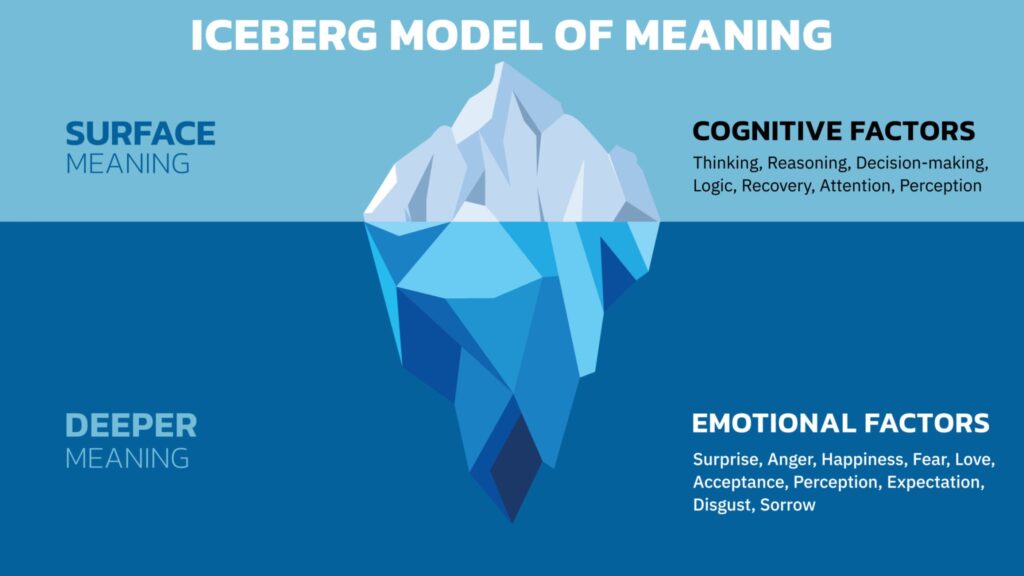
This visualization, titled "Iceberg Model of Meaning," illustrates a concept in psychology and communication that suggests only a small portion of what we perceive is consciously processed, while the vast majority lies beneath the surface. The image uses the metaphor of an iceberg to divide meaning into two main categories: surface meaning and deeper meaning, each influenced by distinct psychological factors.
The Iceberg Model of Meaning. GettyImages.

3. Radical Listening: Understanding is Not Agreement

Many couples listen only to “reload” their next rebuttal. This is a common trap where a normally capable person shows up in the wrong role, the “Prosecutor.”

Real listening in the Imago tradition is about entering your partner’s world, crossing the bridge meeting their unique parts, even if you see the landscape differently.

  • The Mindset Shift: When a person feels genuinely heard, their pulse rate drops and their defences soften.
  • The Golden Rule: Remember, understanding does not mean agreement. It simply means making space for your partner’s reality to exist alongside your own. You’re not conceding the argument; you’re building a bridge.

4. The Mirror Effect: Reflecting to Connect

One of the most transformative tools in relationship work is simple reflection (Mirroring). Before you launch into your “side” of the story, say back what you heard in your own words. I recommend at the start, using your partners exact wording, and then working out the best fit for you both.

  • The Script: “So, if I’m getting this, you felt dismissed and not seen ‘ when I looked at my phone while you were talking? Is that right?” * The Impact: This technique halts the habit of pushing feelings down or avoiding the real issue. It validates your partner’s experience and provides an immediate bridge back to connection. It also gives them the chance to clarify, ensuring you aren’t fighting a ghost of a misunderstanding.

5. Curious Observation: What’s Really Under the Hood?

Most arguments aren’t actually about the dishes, the budget, or the tone of voice. Those are just the stage sets. Underneath the conflict, there is usually a deeper “part” calling out for attention. Is there a feeling of disappointment? Are old childhood patterns repeating themselves?

Curiosity is the antidote to judgment.

  • The Insight: Instead of asking, “Who is right?” ask, “What part is hurting here?” * The Shift: When you view your partner’s reactivity as a temporary state, part with a need, rather than a permanent character flaw, empathy becomes possible. You move from being adversaries to being co-researchers in each other’s happiness.

6. The Art of the Repair: Winning the Relationship, Not the Argument

No couple communicates perfectly 100% of the time. Chris, my husband, and I fight, progress, not perfection. We all slip into reactive states or get a bit “clunky” with our words. What distinguishes a thriving, high-performance relationship is the speed and sincerity of the repair.

  • The Micro-Repair: A gentle touch, a playful wink and smile, or a sincere, “That came out badly—my ‘Calm Captain’ definitely wasn’t at the wheel. Let me try that again.”
  • What’s the The Long-Term Value of the go again? Repair builds a “weather-proof” trust. It reminds both of you that the bond you share is far more important than the point you were trying to prove.

The Path to Conscious Love

Healthy communication isn’t about the total absence of conflict—that’s often just avoidance in disguise! It’s about learning how to stay connected while navigating your differences. By recognising when you’ve lost your way and consciously stepping back into a calm, benchmark state, you transform conflict into a tool for growth. With practice, these tools allow you to show up as the best version of yourself, ready to suit the occasion with the skills

Is it time to move from “Retro” habits to Conscious Connection?

Understanding the 6 communication keys is the blueprint, but building the “Architecture of Connection” happens in the room. If you’re tired of the same old “Vaded” patterns and ready to reclaim your relationship’s “Captain” state, I invite you to a deeper experience.

Join us for the Getting the Love You Want’ Imago Couples specialist weekend program.

It is an immersive, private, and transformative weekend away, designed to turn your conflict into a doorway for healing. No group sharing, just you and your partner, working together, and the tools to build a love that lasts.

From the Workshop Chairs to the Front of the Room: Our Imago Journey

When Chris and I first attended a Getting the Love You Want workshop, we weren’t there as psychologists. We weren’t there to tick a professional box.

We were there as a couple, in marital trouble.

Two life partners who wanted to strengthen our relationship, communicate better, and stop tripping over the same old arguments.

Chris was there with his trademark dry humour, a bit tense but wholeheartedly showing up for us. That weekend changed everything.

For me, it opened up a new way of seeing and being in love. For Chris, who holds a Master’s degree in Clinical Psychology and brings over 40 years of wisdom to his work, it was a refreshing shift: to sit not as the professional, but as a husband, a partner, a learner.

That first workshop didn’t just help us. It inspired us. And it planted a seed that has grown into one of the pinnacles of our lives together.


🎉 The Milestone We’re Celebrating

Fast-forward years of training, study, and supervision, and here we are.

I’ve completed my final faculty assessment and written a full workshop manual, becoming a certified Getting the Love You Want Imago workshop presenter.

This milestone isn’t just about credentials. It’s about completing a circle: from sitting in the chairs as participants, to standing at the front of the room as leaders.

Chris’s Master’s degree in Clinical Psychology gives him the grounding wisdom that couples instantly feel safe with. I bring the spark, energy, and structure that help people lean into the process. Together, we’re more than the sum of our parts — a partnership that lives this work in our marriage, and now gets to share it with you.


❤️ Why Imago Matters Today

Relationships aren’t easy.

We fall in love, we fuse, and then differences surface. That’s when many couples get stuck in the “power struggle” you know it – circling arguments, silence, withdrawal, resentment.

Imago offers a way through.

With its structured dialogue process, couples learn to:

  • Slow down and truly listen
  • Validate each other’s feelings (even when you disagree, Yes)
  • Cross the bridge into your partner’s world with empathy
  • Move from blame, criticism, to curiosity
  • Reignite the safety and playfulness of love

This isn’t theory. It’s practice. Couples feel the shift in the room, in real time.


💬 What Couples Say

“We came in barely talking. We left holding hands with hope again.” – L & A, Sydney

“It felt like hitting the reset button. We laughed, cried, and remembered why we chose each other.” – J & M, Melbourne

“I was sceptical, but this workshop exceeded every expectation. Chris and Philipa create such a safe and inspiring space.” – K & T, Canberra


🔮 Looking Ahead – 2026 I Imago Workshops

With certification complete, we’re preparing to launch our Getting the Love You Want workshop retreats program in 2026.

We’ll only run a handful each year. They’re intentionally small and intimate, so every couple feels supported. And yes — they sell out fast.

Imagine it: two days away from phones, kids, and work. Just you and your partner, guided by two psychologists who live this work every day. A reset, a reconnection, a chance to find each other again.

Would Bali in June be an option – we are taking expressions of interest.


✅ Be The First to Know

If you’d like to be the first to hear when 2026 dates open, join our priority list today.

👉 Join the Priority List for 2026 Workshops

2026 Getting the Love You Want Couples Workshop, 7 & 8 March

We’re thrilled to announce that our first Getting the Love You Want workshop of 2026 will be held on 7 & 8 March in Crows Nest, Sydney Australia.

Unlike group therapy, this workshop is just for you and your partner. You’ll work privately together on structured dialogues, exercises, and reflections.

You never have to share anything with the group unless you genuinely feel moved to. Couples often tell us this gives them both safety and freedom, they’re not put on the spot, yet they feel the collective support of others on the same journey.

Over two transformative days, you can expect to:

  • Discover the hidden roots of recurring conflicts (the “why” behind your arguments)
  • Practise communication skills that turn criticism into curiosity
  • Move through the “power struggle” stage into conscious, intentional partnership
  • Reconnect with empathy, affection, and playfulness
  • Leave with a practical toolkit to keep your love strong long after the weekend ends

❓ Quick answers couples ask

What is the Getting the Love You Want workshop?
It’s a two-day Imago Relationship Therapy program created by Dr Harville Hendrix and Dr Helen LaKelly Hunt. Couples learn how to move from conflict to connection using dialogue, empathy, and relational tools.

Who will be leading the May 2026 Sydney workshop?
It’s facilitated by Philipa Thornton, psychologist, with trusty assistant husband, Chris Paulin, who holds a Master’s degree in Clinical Psychology and over 40 years of experience. Together, we bring both professional expertise, lived partnership, and fun.

Do we have to share with the group?
No. You’ll work privately with your partner. Sharing is optional — only if you feel moved to.

Where is the May 7–8 workshop held?
In Sydney, at a comfortable, welcoming venue designed for safety, learning, and connection.


✅ Reserve your place early

Our next Getting the Love You Want workshop will run on 7 & 8 May 2026 in Sydney.

These weekends are intentionally small, intimate, and sell out quickly. If you’d like to be the first to secure your spot, join our priority list today.


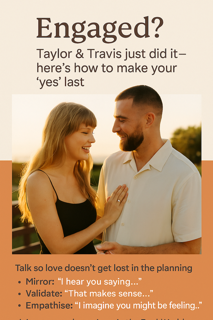
Engaged? Taylor & Travis just did it—here’s how to make your “yes” last

Taylor Swift and Travis Kelce just announced their engagement 💍—cue the glitter, champagne, and endless playlists. If you’re newly engaged, too, congratulations! It’s a magical time, but let’s be honest: planning a wedding can bring as much stress as sparkle.

That’s where Imago Relationship Therapy gives you tools to laugh more, fight less, and grow a marriage that lasts.

At Marriage Works, we believe love lives in the everyday moments—what we call Love in the Real World. Here’s a playful guide to get started.


Talk so love doesn’t get lost in the planning

Wedding chat can turn tense fast (hello, guest lists 🙃). Imago dialogue slows things down so both of you feel heard:

  1. Mirror: “I hear you saying…”
  2. Validate: “That makes sense or I can understand …”
  3. Empathise: “I imagine you might be feeling…”

Try this tonight: Pick one tiny topic (cake flavour, song choice) and practise the three steps. If you end up laughing—bonus points.


Zero negativity (ZNP) = maximum fun

Stress brings snark. Imago’s Zero Negativity Pact helps keep it kind.
Swap: “You never help!”
For: “Would you be willing to call the florist by Friday?”

Couple cue: If negativity sneaks in, one of you says, “Reset?” and you both start fresh.


Small rituals, big connection

Engagement isn’t just planning—it’s practice for the life ahead. Build mini-rituals now:

  • Daily appreciation: one thing you love about your partner (tiny and specific). E.g. I love you, bring me coffee in the morning, you are so thoughtful.
  • Weekly check-in: 30 minutes on connection, logistics, and dreams. E.g. What wins did we have this week? How can we celebrate?
  • Stretching: do one thing that matters to your partner—even if it’s not your style. (Yes, slow dancing in the kitchen counts 💃🕺.)

Why start before the wedding?

Because wedding stress is like a training ground. If you can practise dialogue, zero negativity, and tiny rituals now, you’ll be better prepared for the everyday joys (and bumps) of married life.


💌 Want more?

  • Join our newsletter Love in the Real World for bite-sized inspiration, real stories, and practical tips to keep your relationship thriving.

Getting the Love You Want: A Psychologist’s Journey Into One of the World’s Most Transformative Relationship Workshops

After decades of working as a psychologist, couples therapist, and trainer, I thought I had seen it all when it came to helping people reconnect. Then I experienced the Getting the Love You Want weekend Imago couples workshop. It was unlike anything I had ever encountered: powerful, practical, and deeply moving, and it changed the way I think about relationships, both in my professional work, and in my marriage.

Grounded in Imago Relationship Theory, and Therapy, this internationally acclaimed program is not only for romantic couples. It is equally powerful for therapists, friends, colleagues, parent–adult child pairs, and adult siblings anyone who wants to communicate more effectively, understand each other more deeply, and build a relationship that lasts.


Where it all Began – A Love Story with Challenges

The Getting the Love You Want workshop was created by Dr Harville Hendrix, and Dr Helen LaKelly Hunt in the late 1980s. Their vision grew from both professional expertise, and personal crisis.

At one point, Helen, and Harville’s marriage was on the brink of collapse. They had even flown to New York to tell their children they were divorcing. Before meeting them, they wandered into a bookstore. That chance moment sparked deep conversations about love, safety, and connection. From that turning point, they developed the concepts and practices that became Imago Relationship Therapy (Hendrix & Hunt, 2017).


Meeting Helen in Las Vegas

A few years ago, I had the privilege of meeting Helen at the Imago International Conference in Las Vegas. She shared that story with me in person, and her openness, humour, and hope struck me. Hearing directly from one of the founders reminded me that Imago is not just a therapy model. It is a lived experience, forged in the fire of real-life relationships.


From Pain to a Global Movement

Since its creation, Imago Relationship Therapy has grown into a worldwide movement helping couples, families, and communities. In recent years, Helen, and Harville have refined their work into the 5Rs framework, a clear roadmap for creating and sustaining safe, connected relationships (Hendrix & Hunt, 2021).


The 5Rs: a Roadmap for Re-Connection

When you attend the workshop, you are guided through five key steps:

  1. Re-Commit – Making a conscious choice to invest in your relationship.
  2. Re-Image – Seeing each other with fresh eyes, free from past assumptions.
  3. Re-Structure – Learning the Intentional Dialogue, a structured way to speak and listen without defensiveness.
  4. Re-Romanticise – Rebuilding joy, appreciation, and playfulness.
  5. Re-Vision – Creating a shared vision for the future you both want.

Each step is practised in real time with your partner, colleague, or family member, so you leave not just inspired but equipped with tools you can use immediately. The bonus of having your personal workshop manual to refer to post-workshop is undeniable.


Common Fears

Many people hesitate before attending, wondering:

  • Will we have to share personal details in front of strangers?
    No. This is not group therapy. All personal work happens privately in your pair.
  • Is group sharing mandatory?
    No. Group sharing is optional and focuses on insights, not private stories.
  • What if we argue?
    The safety and structure of the Intentional Dialogue mean reactive patterns are stopped before they spiral. Our team will be there to assist you. You don’t have to go it alone.

While you work privately, seeing others practise can be inspiring. Many participants say that witnessing another pair’s courage helps them believe change is possible in their relationship.

Each step is practised in real time with your partner, colleague or family member, so you leave not only inspired but also equipped with practical tools you can start using straight away. You will also take home your own workshop manual, a valuable resource you can return to again and again to keep building your connection long after the workshop ends.


Is it Only for Couples?

While many people attend with their romantic partner, the workshop is equally powerful for:

  • Therapists attending with a colleague for professional development
  • Parent, and adult child pairs
  • Adult siblings
  • Friends or business partners wanting a deeper understanding and improved communication

Why this Work Matters to Me

As psychologists, and as a married couple, Chris, and I do not just teach relational skills; we use them. The Getting the Love You Want tools have helped us navigate differences, dramas, disconnects, deepen our understanding, and stay connected through the ups and downs of life.

Attending this weekend workshop with Chris years ago was so powerful, I am now on the journey to becoming a certified Getting the Love You Want Workshop presenter. My goal is to share this life-changing work with couples, families, and colleagues here in Australia soon.


Be the First to Know

If you are curious about the Getting the Love You Want workshop and would like to be the first to hear when I offer it, you can join my mailing list here for updates. I would love to one day meet you and share this wonderful journey with you.


References

Hendrix, H., & Hunt, H. L. (2017). Doing Imago relationship therapy in the space-between: A clinician’s guide. Routledge.


Hendrix, H., & Hunt, H. L. (2019). Getting the love you want: A guide for couples (20th anniversary ed.). St. Martin’s Griffin.


Hendrix, H., & Hunt, H. L. (2021). The space between: The 5Rs of safe and connected relationships. Penguin.


Johnson, S. M. (2019). Attachment theory in practice: Emotionally focused therapy (EFT) with individuals, couples, and families. Guilford Press.


Gottman, J. M., & Silver, N. (2015). The seven principles for making marriage work (2nd ed.). Harmony.


Tatkin, S. (2016). Wired for love: How understanding your partner’s brain and attachment style can help you defuse conflict and build a secure relationship. New Harbinger.

Book an appointment
0434 559 011
Weekdays 9am - 5pm Australian Eastern Daylight Time (UTC +11)

Book an appointment
Getting the Love You Want in August 2026

Hi there, just a quick note that we are running this renowned Imago Couples Workshop in Sydney, Australia.

More details click--> Getting the Love You Want

Next workshop

Sign up for the Marriage Works Monthly Newsletter - Love in the Real World

Discover the secrets the relationship professionals recommend with a free monthly email packed with insights and inspirations for you.

Subscribe Here!