For many couples, intimacy doesn’t disappear overnight.
It fades quietly.
You still care about each other. You still function well as a team. Life keeps moving – work, family, commitments – and from the outside everything looks fine.
But something subtle has changed.
Conversations stay practical. Touch becomes brief or absent. You miss the ease you once had, the friendship, the sense of being emotionally close. You may not argue much, but you don’t feel particularly connected either.
In long-term relationships, this experience is far more common than people realise. And it often leaves couples wondering: Is this just what happens over time?
The answer is no. But what helps is not always what people expect.
Why intimacy fades even when love remains
In our work with couples, we often see that intimacy doesn’t fade because partners stop loving each other. It fades because emotional safety becomes thinner over time.
Small moments of disconnection add up. Missed bids for attention. Conversations that feel tense or go nowhere. Old hurts that never quite get repaired. Each experience subtly teaches the nervous system whether it’s safe to open up or better to stay guarded.
Most couples don’t consciously decide to pull away. They adapt.
They become efficient. Polite. Careful.
And gradually, the relationship shifts from emotionally alive to emotionally managed.
Trying harder or “communicating better” rarely solves this, because intimacy isn’t created by effort alone. It’s created when both partners feel safe enough to be real with each other again.
Why talking about the problem often isn’t the solution
Many couples try to fix fading intimacy by talking about it more.
Ironically, this can make things worse.
When conversations feel charged, one partner may push for closeness while the other pulls back. One feels unheard. The other feels criticised. Both leave the interaction feeling less safe than before.
This isn’t a lack of goodwill. It’s a lack of structure.
Without a container that slows things down and reduces reactivity, even well-intentioned conversations can reinforce distance rather than heal it.
What actually helps when intimacy fades
What helps most is not insight alone, but experience.
Couples need opportunities to experience each other differently – to listen and be listened to in ways that feel safe, contained, and meaningful. When the nervous system settles, intimacy often follows naturally.
This is the foundation of the Getting the Love You Want workshop. This couple’s intensive weekend retreat has helped thousands of couples reconnect, re-experience joy and renew desire.
Rather than analysing the relationship or focusing on what’s gone wrong, the workshop provides a structured, private environment where couples can reconnect through guided experiences.
It’s not group therapy.
It’s not about sharing personal stories publicly.
Couples spend most of the time working one-to-one with each other, supported by a clear relational process that helps conversations slow down and feel safer.
What couples often notice during the workshop
Many couples are surprised by what shifts.
They notice how quickly defensiveness drops when conversations are structured. They begin to hear their partner in a new way – not just the words, but the meaning underneath.
For couples who have lost a sense of friendship, this can be deeply relieving. Instead of feeling like they’re negotiating or defending positions, they experience moments of genuine understanding.
These moments matter. Intimacy is rebuilt not through grand gestures, but through repeated experiences of feeling emotionally met.
Why this approach works for long-term couples
Long-term relationships carry history. Patterns. Memory.
The Getting the Love You Want workshop is based on an internationally recognised relationship model that understands this reality. Rather than blaming individuals or labelling relationships as “unhealthy,” it focuses on how connection is created, lost, and restored over time.
This approach has been used by couples around the world because it respects both partners and prioritises safety. When people feel safe, closeness becomes possible again.
“We’re not in crisis – is this still relevant?”
This is one of the most common questions couples ask.
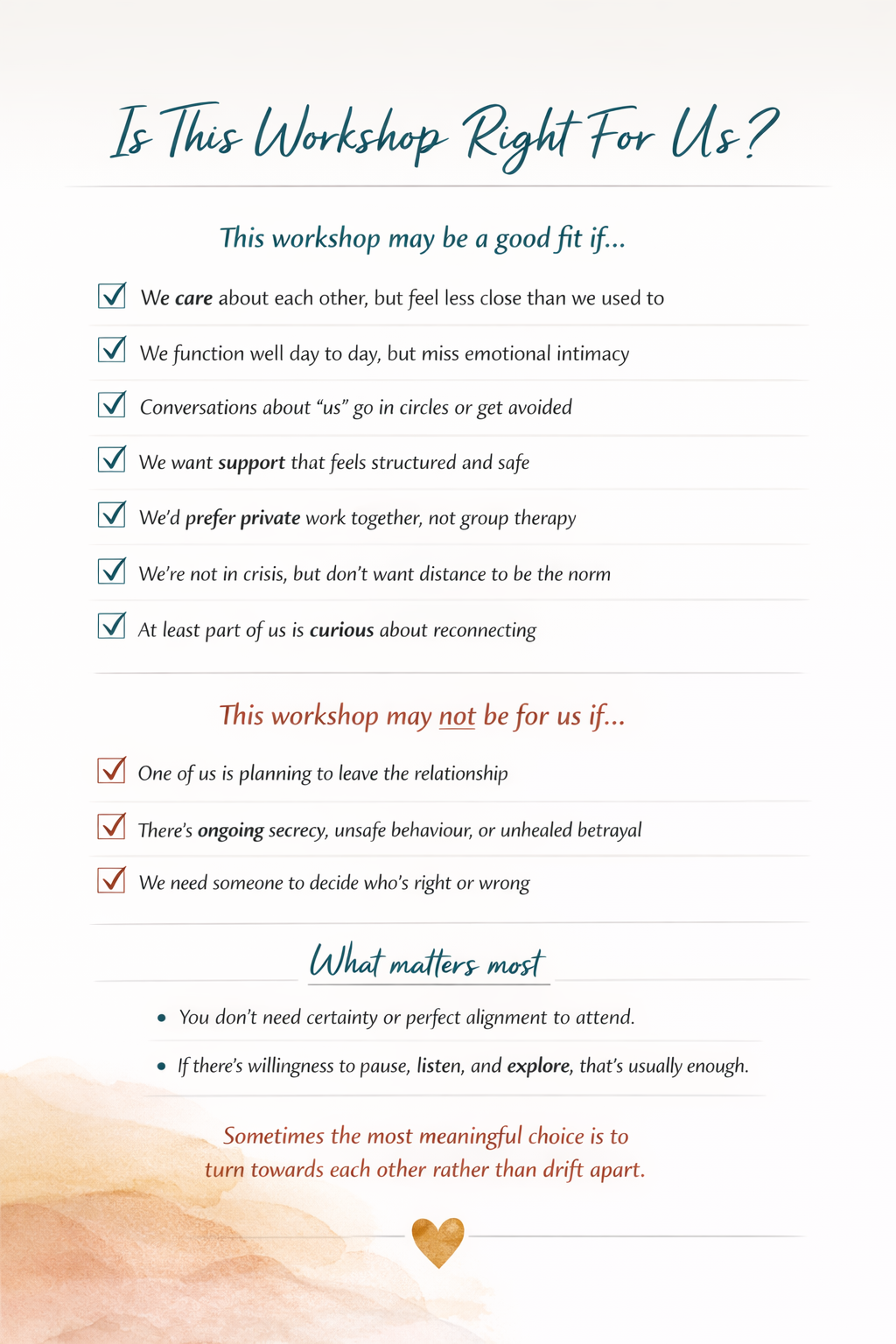
The truth is that many of the couples who benefit most are not in crisis at all. They are still committed. They still care. They simply don’t want emotional distance to become the norm.
Intervening at this stage is often far more effective than waiting until resentment or withdrawal has taken hold.
Choosing to invest in connection early is not an admission of failure. It’s an act of care for you, your relationship and your loved ones.
A different kind of choice
When intimacy fades, couples often tell themselves they’ll deal with it later, when things slow down, when life is less busy, when it becomes unavoidable.
But closeness rarely returns on its own.
The Getting the Love You Want workshop offers couples a chance to pause, step out of daily patterns, and reconnect in a way that is structured, respectful, and deeply human.
Not because something is broken.
But because what matters deserves attention.
Sometimes what actually helps is not waiting, not pushing harder, and not drifting further apart, but deliberately choosing to turn back towards each other.
Frequently Asked Questions
Is this workshop only for couples in crisis?
No. Many couples attend because they still care deeply about each other but feel less connected than they used to. The workshop is especially helpful when intimacy and friendship have faded, even if there’s no major conflict.
Is the Getting the Love You Want workshop group therapy?
No. This is not group therapy. While the workshop is held with other couples present, most of the work is done privately, one-to-one with your partner. Sharing with the group is always optional.
What if we’re not good at talking about feelings?
That’s very common. The workshop provides a clear structure that helps conversations feel safer and less overwhelming. You don’t need to be articulate or emotionally skilled to benefit.
Do we need to prepare or read anything beforehand?
No preparation is required. You simply come as you are. The workshop is designed to meet couples where they’re at, without homework or prior reading.
How is this different from couples counselling?
Rather than ongoing sessions, the workshop offers a focused, immersive experience over two days. Many couples find this helps them shift patterns more quickly and gives them tools they can continue using afterwards.
What if one of us is unsure about attending?
That hesitation is very common. You don’t need to be certain or have a shared goal beyond wanting things to feel better. Curiosity and willingness are enough.
Yes, I want to get the love you want!