Last September brought a moment that truly stopped me in my tracks.
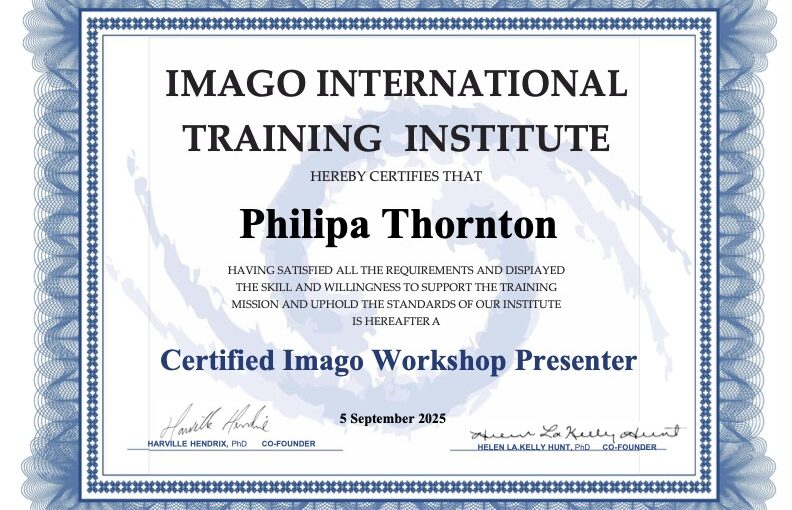
Opening the official confirmation from the Imago International Training Institute felt like such a full circle moment. Wow!
Holding that certificate signed by Harville Hendrix and Helen LaKelly Hunt was not just a professional tick in a box.
It was a deep affirmation of the work Chris and I pour into helping couples rebuild, reconnect, and rediscover each other.
Becoming a Certified Imago Workshop Presenter has been one of the most rewarding and challenging steps in my career.
Countless hours of preparation, meetings, workshops, performance feedback, travel to NZ and zoom calls. Phew it took me nearly two years and $20k. Not a small investment – but totally worth every penny.
The real magic isn’t the piece of paper.
It is what happens inside the room when couples sit down together and finally learn how to truly listen.
I know this as this was Chris and my introduction to Imago eight years ago. Truly I didn’t think a weekend would work. Boy was I surprised by Satruday night we were more connected and playful (smiley face here) than we’d been in months. Sure turned me on to Imago.
What Actually Happens at Getting the Love You Want?
If you have ever felt like you and your partner are speaking two completely different languages, you are not alone. Most couples do not struggle because they lack love. They struggle because they lack a clear translation tool. It’s not group therapy – you only work with your partner. You get your own personal manual each to take home.
During our weekend intensive, we peel back the noise and focus on practical, transformational relational tools:
The Imago Dialogue: Moving past the urge to defend or debate, and stepping into a structured conversation where both of you feel heard and validated.
Understanding Unconscious Triggers: Unpacking why certain small moments spark big reactions, and how to heal those wounds together rather than picking at them.
Restoring Joy and Intimacy: Shifting your relationship dynamic from constant compromise back to genuine safety, warmth, and fun.
Join Us This Weekend in Sydney
We are running our Getting the Love You Want couples workshop again this coming weekend at the Crows Nest Community Centre.
Whether you are looking to repair a fragile patch or simply want to take a good relationship to a much deeper level, we would love to guide you through it.
Event: Getting the Love You Want Imago Couples Workshop
Facilitators: Philipa Thornton(Certified Imago Presenter) and husband consultant psychologist Chris Paulin
Most couples don’t break up because of a single explosion. They break up because of the “Slow Drift” the gradual accumulation of unheard words, ignored needs, and the repetitive, exhausting cycles of reactivity.
If you are reading this, you’ve likely felt that drift.
You’ve felt the pang of loneliness while sitting right next to your partner.
You’ve wondered if the person you fell in love with is still in there.
On 22–23 August 2026, at our exclusive workshop in Crows Nest, Sydney, we are going to stop the drift. This is the “Getting The Love You Want” Workshop, and it is designed to be the most important 48 hours your relationship will ever experience.
Why Conventional Advice Fails (And Why This Workshop Works)
Most relationship advice tells you to “just talk more.” But if you’re talking from a place of defensiveness, you’re just practicing how to fight.
Presented by renowned psychologists Philipa Thornton and Chris Paulin, this workshop utilizes the Imago Relationship Therapy Framework, a method that bypasses the ego and speaks directly to the heart’s need for safety.
What Makes This a “Must-Attend” Couples Intensive Experience?
1. The Privacy Guarantee
We understand the hesitation. You don’t want to air your “dirty laundry” to strangers. This is not group therapy. While the theory is taught in a group, every single practical exercise is done privately and exclusively between you and your partner. Your privacy is our clinical priority.
2. Moving Beyond Blame to Breakthrough
We move you from “You always…” to “I feel…” using the Safety Mechanism. You will learn to:
Identify Your “Cycle”: Pinpoint exactly where your communication breaks down before it turns into a conflict.
Master Emotional Mirroring: Learn the specific verbal tools that ensure your partner feels 100% heard, validated, and seen.
Restore the Spark: Use practical, clinical tools to rebuild the warmth, playfulness, and emotional closeness that have been buried under the stress of daily life.
3. The Momentum for Referring Clinicians
If you are already in therapy, this weekend acts as a “quantum leap.” It provides the concentrated structure and language that can take months to achieve in standard weekly sessions. You will return to your couples therapist refreshed and ready to go.
The Behavioral Science of Love
Our brains are wired for connection, but they are also wired for survival. When we feel criticized, our “reptilian brain” takes over, and we either fight, flee, or freeze. Philipa and Chris teach you how to soothe that survival instinct, allowing you to return to a state of Stronger Connection and Lasting Love.
Event Logistics & Premium Experience
When: 22–23 August 2026
Where: Crows Nest, Sydney
Facilitators: Philipa Thornton & Chris Paulin (Psychologists | Marriage Works)
Investment: Your relationship is the foundation of your family, your finances, and your health. This is the most significant investment you can make this year.
Your Call: Choose Connection Over Conflict
There is a cost to waiting. Every day spent in “the drift” makes the path back slightly longer. This August, give your relationship the gift of a fresh start.
Seats are strictly limited to maintain an intimate, premium environment. This event consistently sells out because it works.
Don’t wait for the crisis. Build the connection now.
For many couples, intimacy doesn’t disappear overnight.
It fades quietly.
You still care about each other. You still function well as a team. Life keeps moving – work, family, commitments – and from the outside everything looks fine.
But something subtle has changed.
Conversations stay practical. Touch becomes brief or absent. You miss the ease you once had, the friendship, the sense of being emotionally close. You may not argue much, but you don’t feel particularly connected either.
In long-term relationships, this experience is far more common than people realise. And it often leaves couples wondering: Is this just what happens over time?
The answer is no. But what helps is not always what people expect.
Why intimacy fades even when love remains
In our work with couples, we often see that intimacy doesn’t fade because partners stop loving each other. It fades because emotional safety becomes thinner over time.
Small moments of disconnection add up. Missed bids for attention. Conversations that feel tense or go nowhere. Old hurts that never quite get repaired. Each experience subtly teaches the nervous system whether it’s safe to open up or better to stay guarded.
Most couples don’t consciously decide to pull away. They adapt.
They become efficient. Polite. Careful. And gradually, the relationship shifts from emotionally alive to emotionally managed.
Trying harder or “communicating better” rarely solves this, because intimacy isn’t created by effort alone. It’s created when both partners feel safe enough to be real with each other again.
Why talking about the problem often isn’t the solution
Many couples try to fix fading intimacy by talking about it more.
Ironically, this can make things worse.
When conversations feel charged, one partner may push for closeness while the other pulls back. One feels unheard. The other feels criticised. Both leave the interaction feeling less safe than before.
This isn’t a lack of goodwill. It’s a lack of structure.
Without a container that slows things down and reduces reactivity, even well-intentioned conversations can reinforce distance rather than heal it.
What actually helps when intimacy fades
What helps most is not insight alone, but experience.
Couples need opportunities to experience each other differently – to listen and be listened to in ways that feel safe, contained, and meaningful. When the nervous system settles, intimacy often follows naturally.
This is the foundation of the Getting the Love You Want workshop. This couple’s intensive weekend retreat has helped thousands of couples reconnect, re-experience joy and renew desire.
Rather than analysing the relationship or focusing on what’s gone wrong, the workshop provides a structured, private environment where couples can reconnect through guided experiences.
It’s not group therapy. It’s not about sharing personal stories publicly.
Couples spend most of the time working one-to-one with each other, supported by a clear relational process that helps conversations slow down and feel safer.
What couples often notice during the workshop
Many couples are surprised by what shifts.
They notice how quickly defensiveness drops when conversations are structured. They begin to hear their partner in a new way – not just the words, but the meaning underneath.
For couples who have lost a sense of friendship, this can be deeply relieving. Instead of feeling like they’re negotiating or defending positions, they experience moments of genuine understanding.
These moments matter. Intimacy is rebuilt not through grand gestures, but through repeated experiences of feeling emotionally met.
Why this approach works for long-term couples
Long-term relationships carry history. Patterns. Memory.
The Getting the Love You Want workshop is based on an internationally recognised relationship model that understands this reality. Rather than blaming individuals or labelling relationships as “unhealthy,” it focuses on how connection is created, lost, and restored over time.
This approach has been used by couples around the world because it respects both partners and prioritises safety. When people feel safe, closeness becomes possible again.
“We’re not in crisis – is this still relevant?”
This is one of the most common questions couples ask.
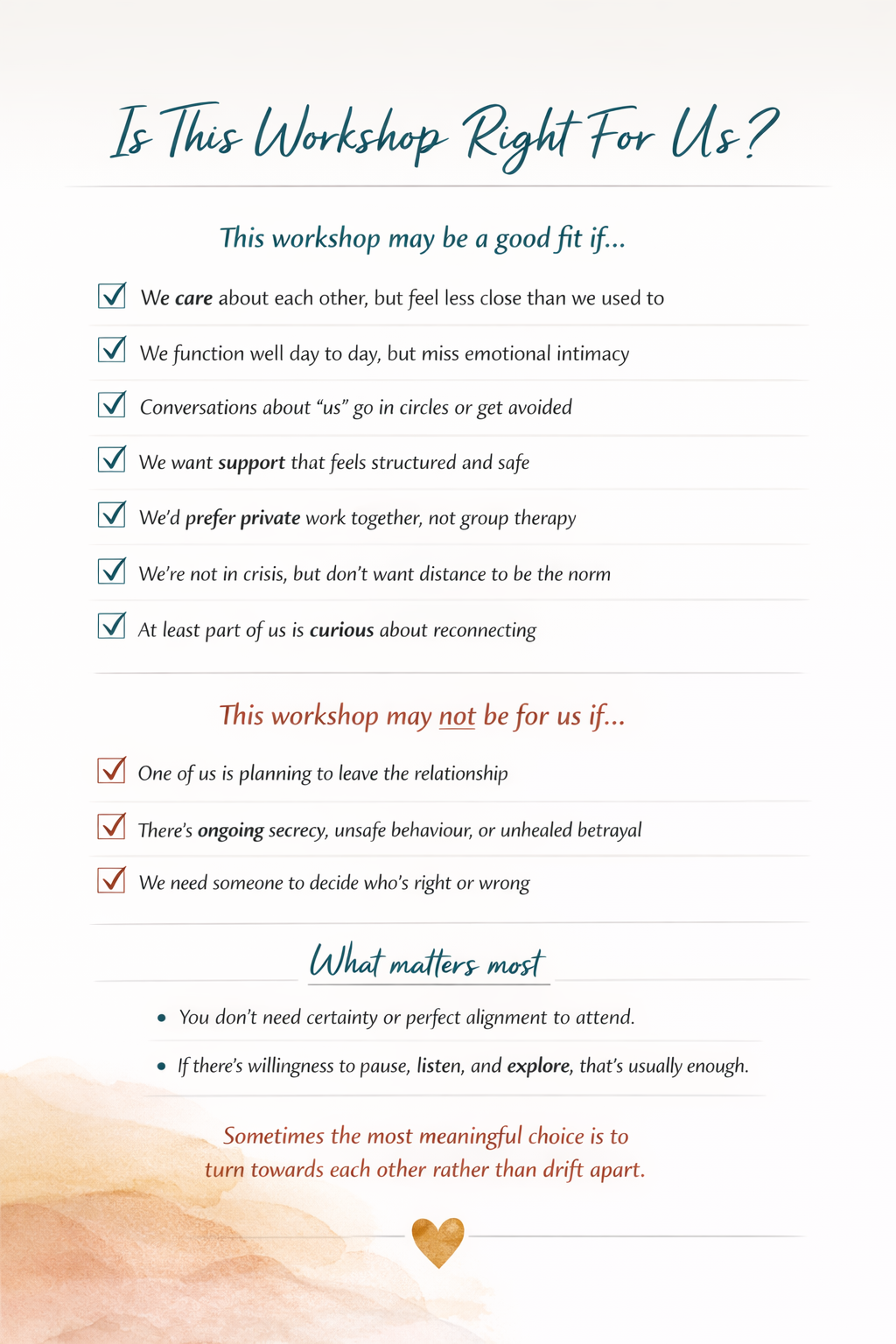
The truth is that many of the couples who benefit most are not in crisis at all. They are still committed. They still care. They simply don’t want emotional distance to become the norm.
Intervening at this stage is often far more effective than waiting until resentment or withdrawal has taken hold.
Choosing to invest in connection early is not an admission of failure. It’s an act of care for you, your relationship and your loved ones.
A different kind of choice
When intimacy fades, couples often tell themselves they’ll deal with it later, when things slow down, when life is less busy, when it becomes unavoidable.
But closeness rarely returns on its own.
The Getting the Love You Want workshop offers couples a chance to pause, step out of daily patterns, and reconnect in a way that is structured, respectful, and deeply human.
Not because something is broken. But because what matters deserves attention.
Sometimes what actually helps is not waiting, not pushing harder, and not drifting further apart, but deliberately choosing to turn back towards each other.
Frequently Asked Questions
Is this workshop only for couples in crisis?
No. Many couples attend because they still care deeply about each other but feel less connected than they used to. The workshop is especially helpful when intimacy and friendship have faded, even if there’s no major conflict.
Is the Getting the Love You Want workshop group therapy?
No. This is not group therapy. While the workshop is held with other couples present, most of the work is done privately, one-to-one with your partner. Sharing with the group is always optional.
What if we’re not good at talking about feelings?
That’s very common. The workshop provides a clear structure that helps conversations feel safer and less overwhelming. You don’t need to be articulate or emotionally skilled to benefit.
Do we need to prepare or read anything beforehand?
No preparation is required. You simply come as you are. The workshop is designed to meet couples where they’re at, without homework or prior reading.
How is this different from couples counselling?
Rather than ongoing sessions, the workshop offers a focused, immersive experience over two days. Many couples find this helps them shift patterns more quickly and gives them tools they can continue using afterwards.
What if one of us is unsure about attending?
That hesitation is very common. You don’t need to be certain or have a shared goal beyond wanting things to feel better. Curiosity and willingness are enough.
No affairs. No dramatic blow-ups. No talk of separation.
From the outside, they look like a solid couple. They work, parent, manage life, and get through the week. There’s care, loyalty, and shared history.
Yet somewhere along the way, the aliveness between them has faded.
Evenings are quieter than they used to be. Conversations stay practical. Touch is brief. Intimacy feels awkward or effortful.
When they try to talk about it, the conversation goes in circles, or one of them shuts down.
Eventually, one of them says it out loud:
“We love each other, but something is missing.”
This is a composite couple, drawn from the many couples who come to this work. And if this sounds familiar, you’re not alone.
Why talking harder hasn’t worked
Most couples in this place have already tried.
They’ve had “the talk”. They’ve promised to try harder. They’ve read articles or listened to podcasts.
And yet, nothing really shifts.
That’s because disconnection isn’t usually a communication problem. It’s a relational safety problem.
Over time, small hurts accumulate. Moments of feeling unseen or misunderstood don’t quite get repaired. Each partner adapts in quiet ways – withdrawing a little, pleasing a little more, avoiding certain topics, protecting themselves from disappointment.
No one is doing anything wrong. They’re doing what humans do when closeness starts to feel risky.
Love is still there. But safety has thinned.
The insight behind the Getting the Love You Want Imago approach
The Getting the Love You Want workshop is grounded in Imago Relationship Therapy, a relationship model developed over four decades ago.
Imago began with a deceptively simple question: Why do loving relationships so often get stuck in the same painful patterns?
The answer was both relieving and confronting.
According to Imago, we are unconsciously drawn to partners who reflect not only the best of what we knew growing up, but also the unresolved emotional wounds. Not because we enjoy pain, but because our nervous system is seeking growth, repair, and completion.
This explains something many couples quietly struggle with:
Why the person you love most can also trigger you most. Why the same arguments repeat, even with good intentions. Why trying harder doesn’t necessarily create closeness.
Rather than seeing conflict as failure, Imago reframes it as a signal – an invitation to slow down, listen differently, and rebuild connection with intention.
From a therapy model to a global relationship movement
What began in therapy rooms quickly grew into a global approach to relationship repair and growth.
Imago Relationship Therapy is now practised in nearly 50 countries, with thousands of trained professionals supporting couples worldwide. The book Getting the Love You Want became an international bestseller because it offered something many couples had never experienced before:
A way to understand why they were stuck A structure for difficult conversations And a path back to connection without blame
Today, the Getting the Love You Want workshop is one of the most widely attended relationship workshops in the world, offered across the US, UK, Europe, and Australia.
Not because it promises perfection – but because it creates safety.
Why the workshop format works so well
Many couples arrive having already tried counselling or “talking it through” on their own.
What’s different about this workshop is the container.
It’s not group therapy. It’s not about sharing your story publicly.
It’s a private, structured, two-day experience where you work primarily one-to-one with your partner, guided through a clear process that helps you:
Slow conversations down so they don’t escalate
Feel heard without defensiveness
Speak without blame or shutdown
Understand what’s happening beneath the surface
Rebuild safety, step by step
Most of the work happens between the two of you. Sharing with the group is always optional.
Couples often say the workshop creates a different kind of shift because you’re not dipping in and out of the work. You’re immersed. Supported. Contained.
Instead of analysing your relationship, you experience being listened to differently.
And that experience is what creates change.
“We’re not in crisis – is this still for us?”
One of the biggest myths about relationship support is that you need to be at breaking point.
In reality, many couples attend the Getting the Love You Want workshop at exactly the point where things are still intact, but connection is thinning.
They’re committed. They care. They just don’t feel met anymore.
This is often the most powerful moment to intervene.
Because rebuilding connection is far easier than repairing damage done by years of emotional distance, resentment, or quiet loneliness.
An invitation to choose each other again
If you recognised yourself in this story – loving each other, functioning well, but sensing that something essential is missing – this is your gentle nudge.
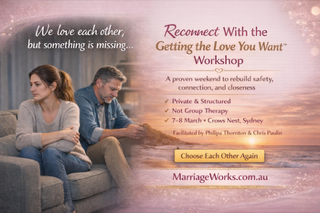
The Getting the Love You Want relationship workshop is running 7–8 March in Crows Nest, Sydney.
It’s private. It’s structured. And it’s designed for couples who want to reconnect before disconnection becomes the norm.
You don’t need to be in crisis. You just need to be willing to slow down and choose each other again.
When Chris and I first attended a Getting the Love You Want workshop, we weren’t there as psychologists or presenters. We were there as a couple.
Two life partners who wanted to strengthen our relationship, communicate better, and stop going around in the same familiar loops.
That first weekend changed everything.
We sat side by side, learning how to slow down, really listen, and understand each other in new ways.
For Chris, who holds a Master’s degree in Clinical Psychology and brings over 40 years of experience to his work, it was refreshing to sit in the chairs simply as a partner. For me, it was deeply moving to feel our connection shift in real time.
Chris, true to form, though nervous, was also cheering me on with his quiet humour, keeping time, offering snacks, and grounding the moment when things felt intense. That experience didn’t just support our relationship. It inspired us both.
Thats why we want to invite you to our next Getting the Love You Want Couples Workshop – we know we did!
In a world that often feels uncertain and heavy, your relationship can become a safe harbour. When the seas are stormy, it’s easy for the stressed, anxious, or serious parts of us to grab the wheel. Yet, beneath the surface, your joyful, playful, and hopeful states are still there — waiting to be invited back on deck.
From an Imago perspective, we care deeply about the issues that divide couples — conflict, disconnection, or unhealed hurts. But just as important is rekindling joy and nurturing the parts of us that celebrate, laugh, and feel most alive. Without joy, repair doesn’t last. Without rituals, love feels adrift.
The Science of Joy and Rituals
The Gottman Institute’s neuroscience research in their relationship lab shows that couples who create rituals of connection, whether a daily hug, a shared coffee, or a playful check-in, activate oxytocin and dopamine pathways. These “feel-good” chemicals build emotional safety and resilience, making couples better able to weather stress.
From a Resource Therapy lens, you can see this as giving voice to the joyful parts of you. When these states steer for a while, the ship of your relationship feels lighter, steadier, and more loving. Now, for some of us, this might be a stretch. I personally grew up in an environment where criticism was seen as encouragement to better yourself. A relic of old thinking, you might notice your own.
Try this Joy Imago Dialogue tonight 🌸
Sit down together, take a deep breath, and explore these prompts:
A small joy I’d love to share with you more often is …
A time I felt most alive and connected with you was …
What helps me celebrate our love is …
💡 Tip: As you listen, notice which part of your partner is speaking. Is it their playful state? Their tender state? Their hopeful state? Mirror back what you hear, and appreciate the part that has shown up.
Why Joy Matters
Every joyful moment is a conscious choice to steer your ship with intention. When couples honour the parts that want joy and fun, they strengthen their love story, creating ripples that echo out into family, friendships, and community.
👉 Your turn: What has recently brought you joy, laughter, or a small celebration in your relationship? Share it in the comments — your story might inspire another couple to reclaim joy, too.
Philipa’s Joy and Celebration Imago Dialogue PDF download here.
By Philipa Thornton, Relationship Psychologist & Imago Couples Therapist President, Resource Therapy International
If I could hand every couple I see one book to read before the wheels fall off, This Is How Your Marriage Ends by Matthew Fray would be high on the list.
Not because it is full of fluffy romantic advice. Not because it gives you a 5-step formula to “fix” your partner. But because it gets painfully real, surprisingly funny, and devastatingly accurate about what actually erodes love.
And spoiler alert – it is not the big betrayals or dramatic moments. It is the empty glass left on the bench after you have asked – again – for it to be put in the dishwasher.
📖 Featured Book: This Is How Your Marriage Ends by Matthew Fray
The Glass Isn’t The Problem – It’s What It Symbolises
Fray knows this because he lived it. A man who lost his marriage not in one catastrophic moment, but through hundreds of tiny, seemingly insignificant moments of “not getting it.” He thought he was a good husband. He was a good guy. But good intentions do not equal good impact.
The book opens with the story of the glass, how his wife asks him to put his used glass in the dishwasher. He doesn’t. She stops asking. And if you’ve ever had a partner, this hits you square in the chest. We all have our ‘glass’.
You can see both sides: the person who thinks “it’s just a glass, what’s the big deal?” and the partner who feels dismissed, disrespected, and unseen – again.
Fray writes with wit and self-deprecating charm, and beneath the humour lies something deeper: a call to wake up to how our everyday behaviours either build trust or slowly dismantle it. There’s hope here.
We Haven’t Been Taught How To Relationship
One of the most refreshing aspects of this book is that Fray doesn’t shame anyone. Instead, he shows us that most of us simply haven’t been taught the skills we need to do relationships well. This fits in with Imago Relationship Coaching beautifully –
We assume love is enough
We assume good intentions matter most
We assume that if something doesn’t make sense to us, it shouldn’t really matter
That – Fray argues – is where so many of us go wrong.
It is this lack of empathy in action that leads to resentment, disconnection, and heartbreak.
What I Love, And What I Recommend
As a couples therapist, I see this dynamic play out in session after session. It is rarely “infidelity”, “money”, or “sex” that is the true issue, though they may be symptoms.
The underlying cause is often this exact pattern Fray describes:
One partner raises a concern (e.g. the glass)
The other minimises it (“It’s not a big deal”)
The first feels dismissed, not heard
The cycle repeats
Resentment builds
Intimacy fades
And finally, someone says, “I just can’t do this anymore”
Fray writes in a way that is particularly accessible, especially for men and anyone who struggles to see how their good intentions can still cause harm. His voice reminds me of The Subtle Art of Not Giving a F*ck by Mark Manson, and the relationship wisdom of The 5 Love Languages.
I especially offer this book to the men I coach who want to understand the nuances – what went wrong, and how to get it right moving forward. It invites insight and ownership, and it does so without shame or blame. It opens up reflection in a way that is honest and transformative.
You will laugh, and you will cringe. You might want to throw the book across the room (especially if your partner is reading it and starts underlining passages). But more than that, you will see yourself, and that is what makes this book so powerful.
Final Thoughts, And A Gentle Invitation
What Fray learned the hard way is something many of us need to learn, ideally before we lose what matters most. It is not just about putting the glass in the dishwasher. It is about showing that your partner’s feelings matter. That their needs matter. That they matter.
And yes, we can learn that.
Whether through books like this, or guided support such as our Imago workshops, therapy, or intensives, healing is possible – and deeply rewarding.
Because maybe – just maybe – this is how your marriage begins again.
I am sure you see it, you hear it, in your therapy rooms, online – worldwide, one issue keeps showing up, and showing up hard: trauma.
Unhealed childhood wounds, nervous system shutdowns, and attachment ruptures are driving conflict, disconnection, and despair in modern relationships. As therapists, we witness couples struggling to love each other through the pain of their pasts.
Too often, we are left wondering: How do I help them heal together, not just survive apart?
That’s exactly what Healing Trauma, Restoring Connection, is here to answer.
🧠 The Heart of the Problem
Trauma, especially developmental or relational trauma, does not stay in the past. It lives in the present moment.
In tone of voice. In body posture. In the silence after a sigh.
When couples are trauma-triggered, logic disappears, and love is no longer safe. They move into fight, flight, freeze, flop, or fawn. Your therapeutic tools need to meet them there.
🛠️ This Is Where Real Change Begins
That’s why we’ve created a transformational two-day workshop designed specifically for psychologists, couples therapists, and trauma-informed practitioners:
Healing Trauma, Restoring Connection 📅 November 8–9, 2025 📍 Crow’s Nest Community Centre, Sydney 🕘 9.00 am – 5.00 pm each day
This is not just another CPD box to tick. This is the kind of professional development that changes your practice, and your confidence forever.
Led by Canadian trauma expert Maureen McEvoy, this workshop blends cutting-edge neuroscience, attachment theory, and parts-based therapy with experiential exercises and real-world skills. You’ll explore how to:
Identify trauma responses in relational conflict
Use co-regulation to create safety in the session
Integrate Imago, PACT, EFT, and creative approaches like art therapy
Work with disorganised attachment and somatic cues
Apply structured interventions that restore connection, not just communication
👩🏫 Why Maureen?
Maureen McEvoy is one of Canada’s most respected trauma clinicians, a Certified Advanced Imago Therapist, and an acclaimed educator at the Justice Institute of British Columbia. With over 30 years of experience and a heart as steady as her clinical wisdom, Maureen brings warmth, clarity, and humor to even the heaviest topics.
💡 Your Invitation to Step Forward
If you’ve been craving more confidence in trauma work… If you’re ready to go beyond theory and into embodied skills… If you want to bring depth and safety into the therapy room—consistently, safely, creatively…
This is your moment, dear couples therapists, couples curious psychologists, and counsellors.
Welcome back to the Marriage Works Monthly Challenge Series. This is really a call to action to encourage share your positive parts to the world. This is for you no matter what your relationship status.
This month as we start to unfurl from lockdown’s, COVID 19 restrictions I ask you to share your kindness.
For some of us, this will be anxiety-provoking, possibly overwhelm, for others of us it may be a relief.
Whatever your reaction is, know it is all within the normal range to an abnormal situation.
Our partners can have their unique reactions to this so please be mindful and generous to their experiences.
So please share kindness. ?
I am a kiwi at home in Sydney (New Zealander for those who don’t know the euphemism). Being from a small town Thames it’s natural to say Hi and smile at folks when we are out and about. This can be such a goodwill gesture and often rewarded in kind.
Start with small.
Sometimes we have the opportunity to do more. I have had a friend who unexpectedly ended up in hospital. She called and I was able to get her clothes, supplies, feed her cat Izzy and support her. She is out now of danger and things are improving thank goodness.
Here’s the YouTube Marriage Works Channel video on Sharing kindness ? Hear how I responded when a lady got anxious and told me off at the mall.
Chris, my spouse is my standard for love and kind treatment. He is my lauchpad for care and respect.
In my rooms I see couples, lone partners and singles all striving for love.
Many times there’s a struggle to find self worth, value and a belief in ourselves as deserving of a loving happy relationship.
Things go off into the ditch.
This is when our negative patterns show up in partnerships.
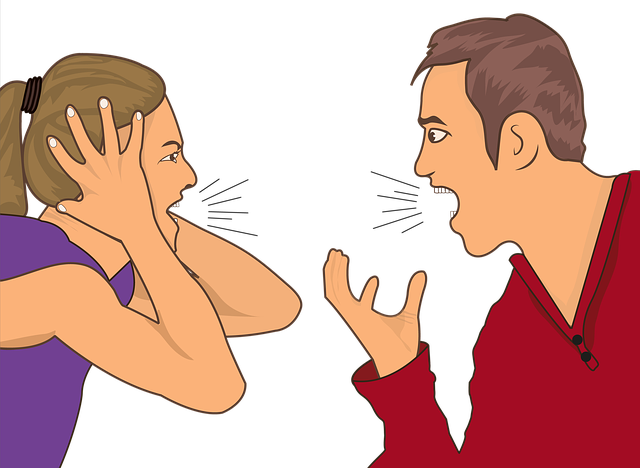
We use the idea of a maximiser – the one who demands and speaks up. They are like the hailstorm and pour down harder to be heard.
Hailstorm Thunder of words can be overwhelming. This is a maximiser trait.
On the flip side is the minimiser. Their pattern is withdrawal. We call these guys the Turtle. They pull back into their shells protectively.
The turtle or tortoise withdraws to protect and minimise, usually invoking more thunder and hail from the maximiser!
Whey I say this to couples they nod knowingly. They usually know whether they are a turtle or a hailstorm in their partnership.
I saw John Aiken pointing out this very dynamic on Married At First Sight. Boy what a hothouse for explosivity. Makes for TV ratings. I love that we are talking about relationships.
This dynamic becomes problematic when it goes off road in the ditch.
When harsh words are said against ones character, foul language and escalation happen.
We can quickly go to the danger zone.
While time outs are a useful tool and necessary tool. It’s vital we learn newer, safer, supportive ways of connecting and communicating.
Danger zone, the frontal lobe is off line. We come from our reptilian brain. Attack and defend naturally occurs as our biology kicks in.
That’s why I coach couples dialogue in my sessions. So your can find a part to help you get your needs met.
You get real world skills to apply in your relationship when the sparks fly.
If a partner comes alone, I always will extend an invitation to attend. Some come, some don’t. Sometimes it’s a new beginning or the next stage in their partnership.
One gentleman I saw for 10-12 sessions solo, by the end of our work they were happily engaged. Gorgeous pictures of roses, rings and romance. Ah love my work!
Occasionally my radar goes up where I hear contempt and threats. I gently query how the person feels on the end of this – this is the marker and what if any repair happens.
When there are excuses, blame and no accountability, I get concerned.
While I totally believe people can change. The proviso is they must want the change for themselves.
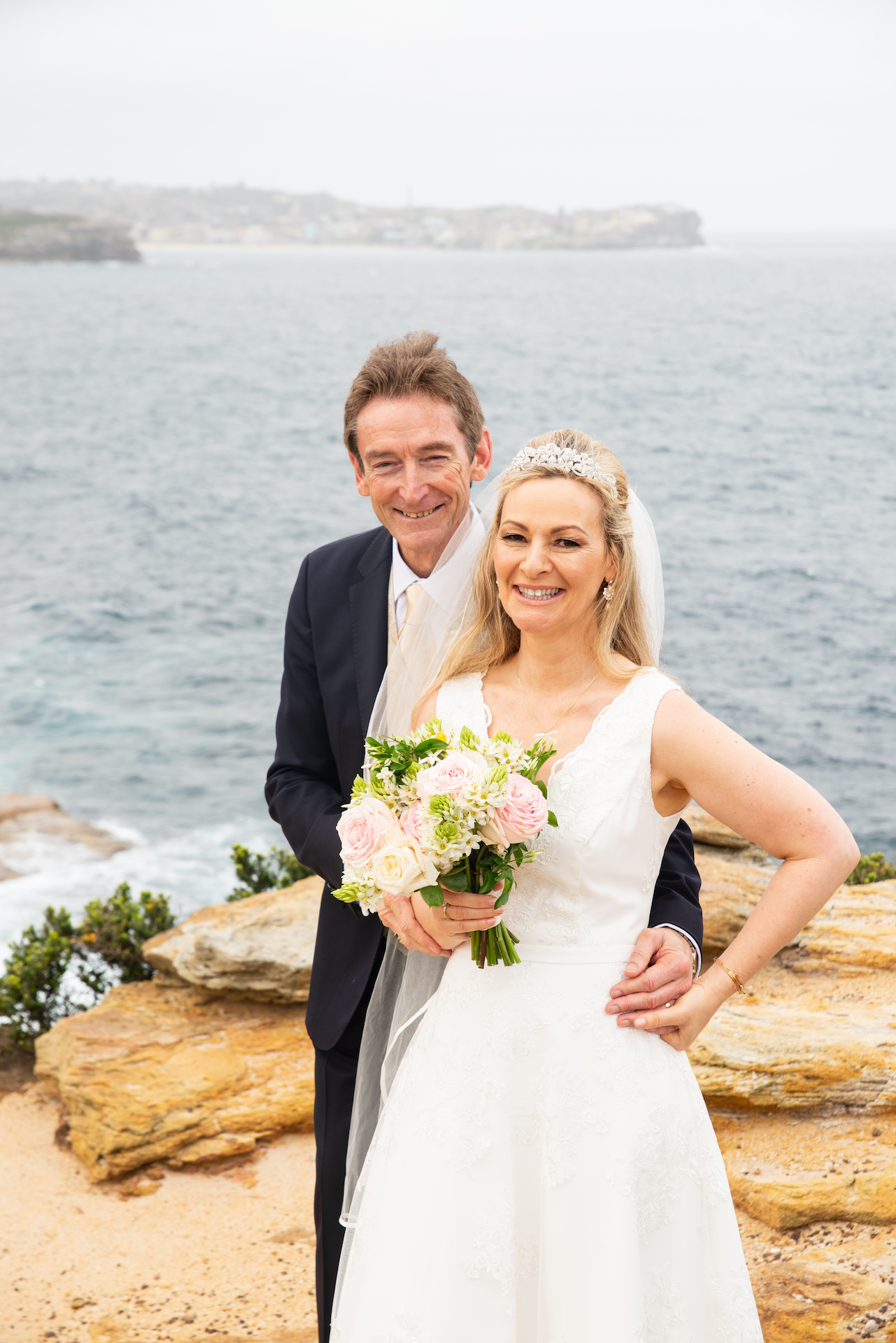
It’s usually then I point to a picture of us on our wedding day and say this is Chris. He would never say $%$^ to me. I have haven’t ever heard him use foul language apart from the rare stubbed toe expletive.
Chris wouldn’t ever say or treat me in that way. I trust him to support me and have my back. While we may not agree on everything, it’s all up for negotiation.
No he’s not an angel but he is good, kind and acts with restraint. Guess who’s the turtle here!
Respect is a cornerstone in a healthy relationship and it’s important we restore it quickly when it’s lost. No one’s perfect!
You are welcome to use Chris as a baseline too!
Ask yourself if there is a person or partnership you admire. Would they act that way, or say that ?
Perhaps we can require more of ourselves and our partners as we learn and grow together. Go gently and live fully. Yours in gratitude Philipa xox
Book an appointment 0434 559 011
Weekdays 9am - 5pm Australian Eastern Daylight Time (UTC +11)
Book an appointment
Getting the Love You Want in August 2026
Hi there, just a quick note that we are running this renowned Imago Couples Workshop in Sydney, Australia.