Last September brought a moment that truly stopped me in my tracks.
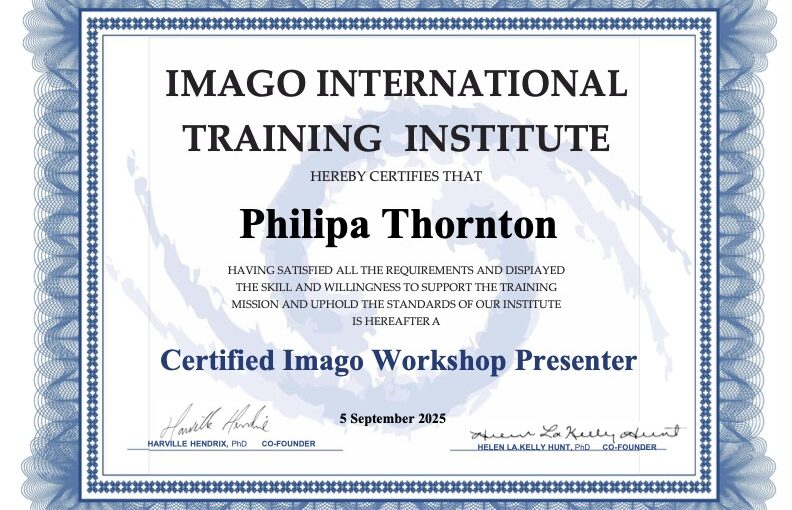
Opening the official confirmation from the Imago International Training Institute felt like such a full circle moment. Wow!
Holding that certificate signed by Harville Hendrix and Helen LaKelly Hunt was not just a professional tick in a box.
It was a deep affirmation of the work Chris and I pour into helping couples rebuild, reconnect, and rediscover each other.
Becoming a Certified Imago Workshop Presenter has been one of the most rewarding and challenging steps in my career.
Countless hours of preparation, meetings, workshops, performance feedback, travel to NZ and zoom calls. Phew it took me nearly two years and $20k. Not a small investment – but totally worth every penny.
The real magic isn’t the piece of paper.
It is what happens inside the room when couples sit down together and finally learn how to truly listen.
I know this as this was Chris and my introduction to Imago eight years ago. Truly I didn’t think a weekend would work. Boy was I surprised by Satruday night we were more connected and playful (smiley face here) than we’d been in months. Sure turned me on to Imago.
What Actually Happens at Getting the Love You Want?
If you have ever felt like you and your partner are speaking two completely different languages, you are not alone. Most couples do not struggle because they lack love. They struggle because they lack a clear translation tool. It’s not group therapy – you only work with your partner. You get your own personal manual each to take home.
During our weekend intensive, we peel back the noise and focus on practical, transformational relational tools:
The Imago Dialogue: Moving past the urge to defend or debate, and stepping into a structured conversation where both of you feel heard and validated.
Understanding Unconscious Triggers: Unpacking why certain small moments spark big reactions, and how to heal those wounds together rather than picking at them.
Restoring Joy and Intimacy: Shifting your relationship dynamic from constant compromise back to genuine safety, warmth, and fun.
Join Us This Weekend in Sydney
We are running our Getting the Love You Want couples workshop again this coming weekend at the Crows Nest Community Centre.
Whether you are looking to repair a fragile patch or simply want to take a good relationship to a much deeper level, we would love to guide you through it.
Event: Getting the Love You Want Imago Couples Workshop
Facilitators: Philipa Thornton(Certified Imago Presenter) and husband consultant psychologist Chris Paulin
For many couples, intimacy doesn’t disappear overnight.
It fades quietly.
You still care about each other. You still function well as a team. Life keeps moving – work, family, commitments – and from the outside everything looks fine.
But something subtle has changed.
Conversations stay practical. Touch becomes brief or absent. You miss the ease you once had, the friendship, the sense of being emotionally close. You may not argue much, but you don’t feel particularly connected either.
In long-term relationships, this experience is far more common than people realise. And it often leaves couples wondering: Is this just what happens over time?
The answer is no. But what helps is not always what people expect.
Why intimacy fades even when love remains
In our work with couples, we often see that intimacy doesn’t fade because partners stop loving each other. It fades because emotional safety becomes thinner over time.
Small moments of disconnection add up. Missed bids for attention. Conversations that feel tense or go nowhere. Old hurts that never quite get repaired. Each experience subtly teaches the nervous system whether it’s safe to open up or better to stay guarded.
Most couples don’t consciously decide to pull away. They adapt.
They become efficient. Polite. Careful. And gradually, the relationship shifts from emotionally alive to emotionally managed.
Trying harder or “communicating better” rarely solves this, because intimacy isn’t created by effort alone. It’s created when both partners feel safe enough to be real with each other again.
Why talking about the problem often isn’t the solution
Many couples try to fix fading intimacy by talking about it more.
Ironically, this can make things worse.
When conversations feel charged, one partner may push for closeness while the other pulls back. One feels unheard. The other feels criticised. Both leave the interaction feeling less safe than before.
This isn’t a lack of goodwill. It’s a lack of structure.
Without a container that slows things down and reduces reactivity, even well-intentioned conversations can reinforce distance rather than heal it.
What actually helps when intimacy fades
What helps most is not insight alone, but experience.
Couples need opportunities to experience each other differently – to listen and be listened to in ways that feel safe, contained, and meaningful. When the nervous system settles, intimacy often follows naturally.
This is the foundation of the Getting the Love You Want workshop. This couple’s intensive weekend retreat has helped thousands of couples reconnect, re-experience joy and renew desire.
Rather than analysing the relationship or focusing on what’s gone wrong, the workshop provides a structured, private environment where couples can reconnect through guided experiences.
It’s not group therapy. It’s not about sharing personal stories publicly.
Couples spend most of the time working one-to-one with each other, supported by a clear relational process that helps conversations slow down and feel safer.
What couples often notice during the workshop
Many couples are surprised by what shifts.
They notice how quickly defensiveness drops when conversations are structured. They begin to hear their partner in a new way – not just the words, but the meaning underneath.
For couples who have lost a sense of friendship, this can be deeply relieving. Instead of feeling like they’re negotiating or defending positions, they experience moments of genuine understanding.
These moments matter. Intimacy is rebuilt not through grand gestures, but through repeated experiences of feeling emotionally met.
Why this approach works for long-term couples
Long-term relationships carry history. Patterns. Memory.
The Getting the Love You Want workshop is based on an internationally recognised relationship model that understands this reality. Rather than blaming individuals or labelling relationships as “unhealthy,” it focuses on how connection is created, lost, and restored over time.
This approach has been used by couples around the world because it respects both partners and prioritises safety. When people feel safe, closeness becomes possible again.
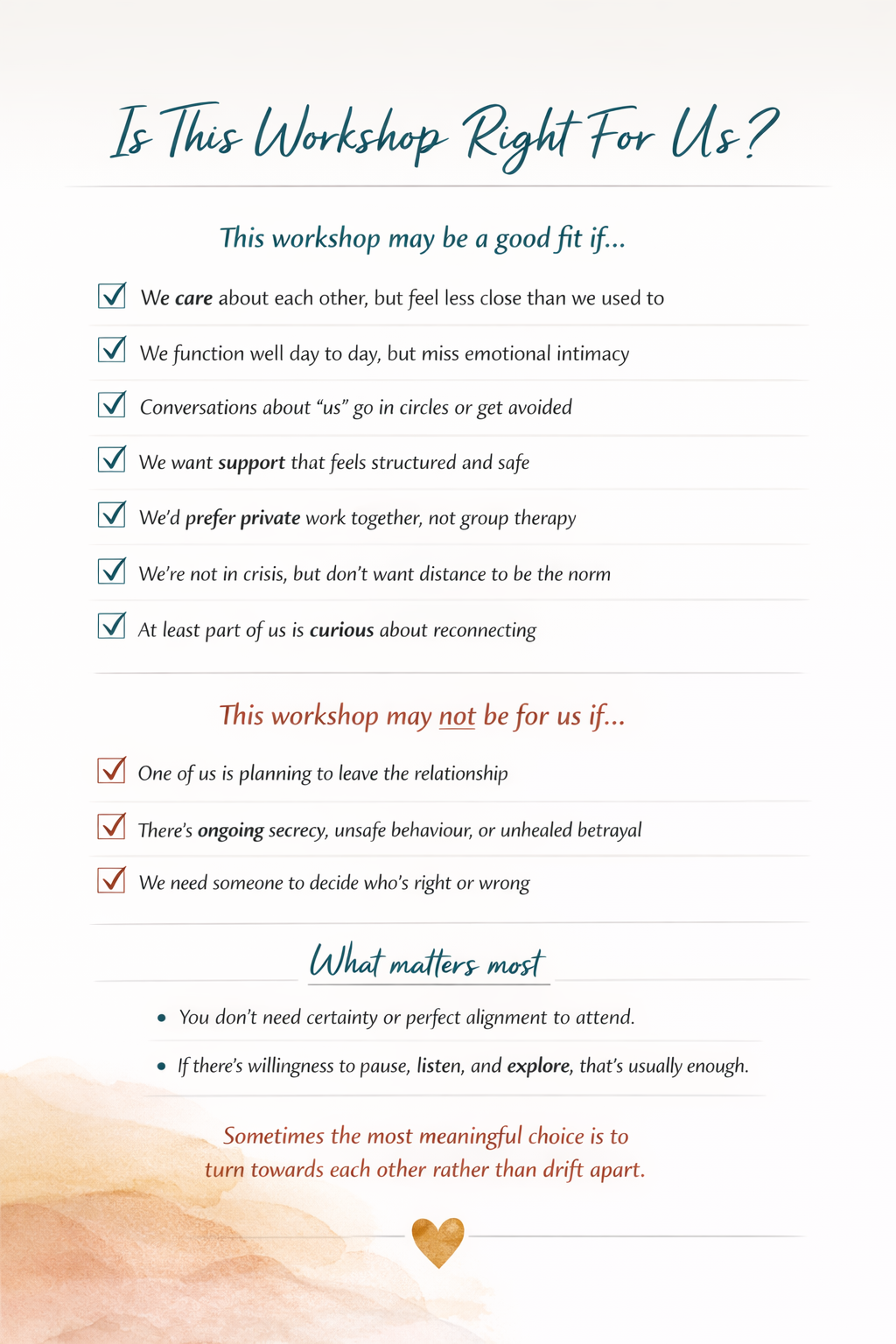
“We’re not in crisis – is this still relevant?”
This is one of the most common questions couples ask.
The truth is that many of the couples who benefit most are not in crisis at all. They are still committed. They still care. They simply don’t want emotional distance to become the norm.
Intervening at this stage is often far more effective than waiting until resentment or withdrawal has taken hold.
Choosing to invest in connection early is not an admission of failure. It’s an act of care for you, your relationship and your loved ones.
A different kind of choice
When intimacy fades, couples often tell themselves they’ll deal with it later, when things slow down, when life is less busy, when it becomes unavoidable.
But closeness rarely returns on its own.
The Getting the Love You Want workshop offers couples a chance to pause, step out of daily patterns, and reconnect in a way that is structured, respectful, and deeply human.
Not because something is broken. But because what matters deserves attention.
Sometimes what actually helps is not waiting, not pushing harder, and not drifting further apart, but deliberately choosing to turn back towards each other.
Frequently Asked Questions
Is this workshop only for couples in crisis?
No. Many couples attend because they still care deeply about each other but feel less connected than they used to. The workshop is especially helpful when intimacy and friendship have faded, even if there’s no major conflict.
Is the Getting the Love You Want workshop group therapy?
No. This is not group therapy. While the workshop is held with other couples present, most of the work is done privately, one-to-one with your partner. Sharing with the group is always optional.
What if we’re not good at talking about feelings?
That’s very common. The workshop provides a clear structure that helps conversations feel safer and less overwhelming. You don’t need to be articulate or emotionally skilled to benefit.
Do we need to prepare or read anything beforehand?
No preparation is required. You simply come as you are. The workshop is designed to meet couples where they’re at, without homework or prior reading.
How is this different from couples counselling?
Rather than ongoing sessions, the workshop offers a focused, immersive experience over two days. Many couples find this helps them shift patterns more quickly and gives them tools they can continue using afterwards.
What if one of us is unsure about attending?
That hesitation is very common. You don’t need to be certain or have a shared goal beyond wanting things to feel better. Curiosity and willingness are enough.
In a world that often feels uncertain and heavy, your relationship can become a safe harbour. When the seas are stormy, it’s easy for the stressed, anxious, or serious parts of us to grab the wheel. Yet, beneath the surface, your joyful, playful, and hopeful states are still there — waiting to be invited back on deck.
From an Imago perspective, we care deeply about the issues that divide couples — conflict, disconnection, or unhealed hurts. But just as important is rekindling joy and nurturing the parts of us that celebrate, laugh, and feel most alive. Without joy, repair doesn’t last. Without rituals, love feels adrift.
The Science of Joy and Rituals
The Gottman Institute’s neuroscience research in their relationship lab shows that couples who create rituals of connection, whether a daily hug, a shared coffee, or a playful check-in, activate oxytocin and dopamine pathways. These “feel-good” chemicals build emotional safety and resilience, making couples better able to weather stress.
From a Resource Therapy lens, you can see this as giving voice to the joyful parts of you. When these states steer for a while, the ship of your relationship feels lighter, steadier, and more loving. Now, for some of us, this might be a stretch. I personally grew up in an environment where criticism was seen as encouragement to better yourself. A relic of old thinking, you might notice your own.
Try this Joy Imago Dialogue tonight 🌸
Sit down together, take a deep breath, and explore these prompts:
A small joy I’d love to share with you more often is …
A time I felt most alive and connected with you was …
What helps me celebrate our love is …
💡 Tip: As you listen, notice which part of your partner is speaking. Is it their playful state? Their tender state? Their hopeful state? Mirror back what you hear, and appreciate the part that has shown up.
Why Joy Matters
Every joyful moment is a conscious choice to steer your ship with intention. When couples honour the parts that want joy and fun, they strengthen their love story, creating ripples that echo out into family, friendships, and community.
👉 Your turn: What has recently brought you joy, laughter, or a small celebration in your relationship? Share it in the comments — your story might inspire another couple to reclaim joy, too.
Philipa’s Joy and Celebration Imago Dialogue PDF download here.
By Philipa Thornton, Relationship Psychologist & Imago Couples Therapist President, Resource Therapy International
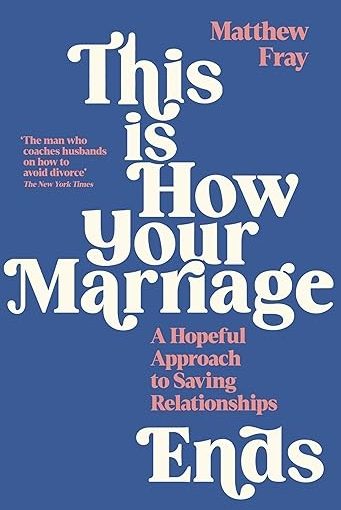
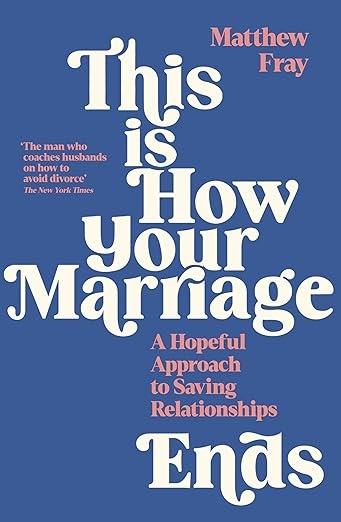
If I could hand every couple I see one book to read before the wheels fall off, This Is How Your Marriage Ends by Matthew Fray would be high on the list.
Not because it is full of fluffy romantic advice. Not because it gives you a 5-step formula to “fix” your partner. But because it gets painfully real, surprisingly funny, and devastatingly accurate about what actually erodes love.
And spoiler alert – it is not the big betrayals or dramatic moments. It is the empty glass left on the bench after you have asked – again – for it to be put in the dishwasher.
📖 Featured Book: This Is How Your Marriage Ends by Matthew Fray
The Glass Isn’t The Problem – It’s What It Symbolises
Fray knows this because he lived it. A man who lost his marriage not in one catastrophic moment, but through hundreds of tiny, seemingly insignificant moments of “not getting it.” He thought he was a good husband. He was a good guy. But good intentions do not equal good impact.
The book opens with the story of the glass, how his wife asks him to put his used glass in the dishwasher. He doesn’t. She stops asking. And if you’ve ever had a partner, this hits you square in the chest. We all have our ‘glass’.
You can see both sides: the person who thinks “it’s just a glass, what’s the big deal?” and the partner who feels dismissed, disrespected, and unseen – again.
Fray writes with wit and self-deprecating charm, and beneath the humour lies something deeper: a call to wake up to how our everyday behaviours either build trust or slowly dismantle it. There’s hope here.
We Haven’t Been Taught How To Relationship
One of the most refreshing aspects of this book is that Fray doesn’t shame anyone. Instead, he shows us that most of us simply haven’t been taught the skills we need to do relationships well. This fits in with Imago Relationship Coaching beautifully –
We assume love is enough
We assume good intentions matter most
We assume that if something doesn’t make sense to us, it shouldn’t really matter
That – Fray argues – is where so many of us go wrong.
It is this lack of empathy in action that leads to resentment, disconnection, and heartbreak.
What I Love, And What I Recommend
As a couples therapist, I see this dynamic play out in session after session. It is rarely “infidelity”, “money”, or “sex” that is the true issue, though they may be symptoms.
The underlying cause is often this exact pattern Fray describes:
One partner raises a concern (e.g. the glass)
The other minimises it (“It’s not a big deal”)
The first feels dismissed, not heard
The cycle repeats
Resentment builds
Intimacy fades
And finally, someone says, “I just can’t do this anymore”
Fray writes in a way that is particularly accessible, especially for men and anyone who struggles to see how their good intentions can still cause harm. His voice reminds me of The Subtle Art of Not Giving a F*ck by Mark Manson, and the relationship wisdom of The 5 Love Languages.
I especially offer this book to the men I coach who want to understand the nuances – what went wrong, and how to get it right moving forward. It invites insight and ownership, and it does so without shame or blame. It opens up reflection in a way that is honest and transformative.
You will laugh, and you will cringe. You might want to throw the book across the room (especially if your partner is reading it and starts underlining passages). But more than that, you will see yourself, and that is what makes this book so powerful.
Final Thoughts, And A Gentle Invitation
What Fray learned the hard way is something many of us need to learn, ideally before we lose what matters most. It is not just about putting the glass in the dishwasher. It is about showing that your partner’s feelings matter. That their needs matter. That they matter.
And yes, we can learn that.
Whether through books like this, or guided support such as our Imago workshops, therapy, or intensives, healing is possible – and deeply rewarding.
Because maybe – just maybe – this is how your marriage begins again.
One of the most joyful concepts in Imago Relationship Therapy is re-romanticising. This concept involves intentionally reviving the spark, appreciation, and playfulness that often fade in long-term relationships.
If you have ever thought, “We love each other, but the fun has disappeared,” you are not alone.
Life gets busy. Stress, work, parenting, and emotional disconnection can take their toll.
But the good news is that connection and joy can return when we put intention behind our actions.
What Is Re-Romanticising?
In Imago Relationship Theory, re-romanticising is about reawakening positive energy in your relationship. It is not about grand gestures or manufactured romance. It is about making small, consistent choices that help your partner feel seen, valued, and loved.
Think of it as a return to those early days when everything felt exciting. But this time, you are doing it with deeper understanding and intention. You choose connection, even when it does not come easily.
Why Fun Is Foundational
One of the most overlooked ingredients in a healthy relationship is fun. Playful moments help us bond, regulate stress, and remember why we chose each other in the first place.
In our Marriage Works couples sessions, we often hear things like:
“We do not laugh together anymore.”
“We have lost our spark.”
“Everything feels like a to-do list.”
If this sounds familiar, it might be time to prioritise joy again. That can look as simple as:
Dancing in the kitchen
Sharing a funny memory or an inside joke
Sending a flirty message midday
Taking a walk without your phones
Playing a silly board game or card game
Joy is not frivolous. It is fuel for emotional safety, resilience, and intimacy.
Bringing Pleasure Back
Another part of re-romanticising is reconnecting physically and emotionally through pleasure. In long-term relationships, physical intimacy can become routine or even disappear altogether.
When we lose playfulness, desire often fades too. But pleasure can be a powerful way to reconnect. Not just sexually, but in all five senses. Holding hands. Making eye contact. Laughing and exploring touch in a non-pressured way.
This is where tools like OMGYes can make a real difference.
What Is OMGYes?
OMGYes is a research-based platform that explores what brings women physical pleasure. Based on findings from over 20,000 people, it offers videos, interviews, and interactive touchable tools that help users explore intimacy with confidence and clarity.
It is practical, inclusive, and designed to help couples talk more openly about what feels good.
Many of the couples we see use OMG Yes as a fun, non-threatening way to start conversations about sex and connection.
It is not therapy, but it can be a helpful complement to your journey together.
Try this: do one thing this week to re-romanticise your relationship. Choose something fun, light, and a little bit unexpected.
Focus on connection, not perfection.
And if you would like structured support with your relationship, consider joining one of our Getting the Love You Want workshops. These transformative weekends help couples heal patterns, increase safety, and bring joy back into the relationship.
Because love is not just about staying together. It is about thriving together.
Philipa Thornton, psychologist and certified Imago Relationship Therapist at Marriage Works. We help couples reconnect through the power of intention, dialogue, and fun.
I can write them easily – Love, Respect, Friendship and Trust. Two dimensional words.
It’s the actions and responses that you show and share with your partner that can make or break your partnership. Are you a good friend?
Are you present, listening, showing care, curiosity and connection? Or are you just going through the motions as you walk through the door?
I am not talking about those still in the romance relationship phase here. This is where we are drugged with nature’s anesthesia as Harville Hendrix calls PEA – Phenylethylamine.
When the PEA wears off as it inevitably will, cracks appear. Our partner eats noisily, forgets to call, leaves without kissing you goodbye.
What attracted you initially now repels you.
All minor things but they build up. Resentment festers. If left too long it seems as if the D-word is the only option.
It’s not, change is possible.
Imago Couple Therapy is designed to help you gain skills, communicate, learn and grow together by applying loving, respectful, and trust-building practices.
So stop the resentment rot from setting in. See a relationship specialist today.
Only the other day in a couple therapy session, a husband and wife joined some of the dots on how their life patterns played out.
Husband said, ” Oh I used to take it personally when I imagined you were prioritizing your friends over me.” His Wife said “I can’t say no to my friends, I over-commit myself. I don’t want to let anyone down or it will feel like a failure to me.” Husband “I see now it’s you wanting to please everyone and where this comes from. What a lot of expectation pressure you put on yourself.” Both said they felt hopeful as this new perspective allowed more love and respect to build.
Relationships a two way street. Keep the avenues open with kindness, gratitude and generosity. Your partner will trigger you. Breathe to calm yourself. Use your words, actions, and deeds to inspire the love you want.
Christmas time can bring a load of feelings. For some of us these are heavy, painful and lonely times. For others, it’s a joyous celebration of connection.
My friend and eminent couples therapist Michele Weiner- Davis’ said at training, we as therapists need to be able to heal relationships. That includes our own circle.
Shutting off or cutting off as it is called in therapy speak it not the most healthy option. Real courage comes from working through the rupture in the relationship to repair and healing.
It is a bias of mine for families to have connections. So in this video, I will show you a Resource Therapy process for clarification. It’s a safe self-help action you can take. I give a quick demonstration.
I think it beats journalling ( although that is good too) as there is something unique in speaking this out with ourselves.
Note I am not suggesting you have the conversation with the person. Rather this is like the letter you write without sending. It is for you to gain insight and hopefully an emotional shift. Love to hear how it went for you. please share your experiences.
Philipa Thornton is your Relationship Psychologist in Sydney, and now worldwide online. Philipa and her husband Chris Paulin run Marriage Works their busy private practice, helping couples re-pair with coupe therapy, heal marital issues to find relationship harmony. We assist singles em-power, heal, and develop healthy internal and external relationships.
As the new year begins, I thought it might be nice to highlight some of the best, most well received articles from the past year.
I have gone through the archives and found articles that gained positive feedback or were particularity powerful and interesting. Hopefully you’ll find a few old favourites here and come across something new to inspire you!
Are you getting the Love you Want? Check out the cheats guide to skipping therapy with a couples retreat to fast track your relationship repair here https://marriageworks.com.au/2019/07/getting-the-love-you-want-couples-workshop/
The best thing you can do for your relationship health and well being is to come in early. Relationships can be repaired. It is so much easier and quicker to learn new ways or communicating and relating before hard core patterns of hurt set in. Waiting for change won’t work and the alternative where there is a breakdown or a crisis like an affair will double or even treble the time, energy and money you will have to channel into your couple therapy.
Not only does all the research confirm this commonsense tells you the truth here. Come in before your spouse says they don’t love you or it’s over.
Why wait for that pain?
Perhaps you have already heard those words. Come in and improve your partnership today I have a quick 4 minute video here encouraging you to take action and save yourself heartache and pain plus money !
Make the call today – take action!
You want this to be a beautiful version of your future – look at this couple.
Live in love together to a ripe age and stage having fun in your marriage.
Welcome to May! Here in Sydney it’s Autumn and the darkness comes early. We’ve been blessed with lovely weather and sunny days as we have had Easter and Anzac Day to honour our war veterans.
This month I have been inspired to offer you the opportunity to say no to negativity in your relationship. As John Gottman -a legend in marital research and divorce saving techniques rightly points out criticism is toxic in partnershps and they believe it takes a 5:1 ratio of good comments to over come one negative one.
So give yourself a break and make it Zero! If you find yourself complaining remind yourself of what you are truly grateful in your marriage. For me I look at Chris and I feel gratitude at having a life companion, someone I enjoy spending time with. He’s a good kind husband.
So take the month of May Relationship Challenge and join me for Zero Negativity and increased positivity!
Love to hear your thoughts, ask your partner to join you or be a solo leader in deed. Please pass on the help by sharing.