

What Actually Helps When Intimacy Fades in Long-Term Relationships

For many couples, intimacy doesn’t disappear overnight.

It fades quietly.

You still care about each other. You still function well as a team. Life keeps moving – work, family, commitments – and from the outside everything looks fine.

But something subtle has changed.

Conversations stay practical. Touch becomes brief or absent. You miss the ease you once had, the friendship, the sense of being emotionally close. You may not argue much, but you don’t feel particularly connected either.

In long-term relationships, this experience is far more common than people realise. And it often leaves couples wondering: Is this just what happens over time?

The answer is no. But what helps is not always what people expect.

Why intimacy fades even when love remains

In our work with couples, we often see that intimacy doesn’t fade because partners stop loving each other. It fades because emotional safety becomes thinner over time.

Small moments of disconnection add up. Missed bids for attention. Conversations that feel tense or go nowhere. Old hurts that never quite get repaired. Each experience subtly teaches the nervous system whether it’s safe to open up or better to stay guarded.

Most couples don’t consciously decide to pull away. They adapt.

They become efficient. Polite. Careful.
And gradually, the relationship shifts from emotionally alive to emotionally managed.

Trying harder or “communicating better” rarely solves this, because intimacy isn’t created by effort alone. It’s created when both partners feel safe enough to be real with each other again.

Why talking about the problem often isn’t the solution

Many couples try to fix fading intimacy by talking about it more.

Ironically, this can make things worse.

When conversations feel charged, one partner may push for closeness while the other pulls back. One feels unheard. The other feels criticised. Both leave the interaction feeling less safe than before.

This isn’t a lack of goodwill. It’s a lack of structure.

Without a container that slows things down and reduces reactivity, even well-intentioned conversations can reinforce distance rather than heal it.

What actually helps when intimacy fades

What helps most is not insight alone, but experience.

Couples need opportunities to experience each other differently – to listen and be listened to in ways that feel safe, contained, and meaningful. When the nervous system settles, intimacy often follows naturally.

This is the foundation of the Getting the Love You Want workshop. This couple’s intensive weekend retreat has helped thousands of couples reconnect, re-experience joy and renew desire.

Rather than analysing the relationship or focusing on what’s gone wrong, the workshop provides a structured, private environment where couples can reconnect through guided experiences.

It’s not group therapy.
It’s not about sharing personal stories publicly.

Couples spend most of the time working one-to-one with each other, supported by a clear relational process that helps conversations slow down and feel safer.

What couples often notice during the workshop

Many couples are surprised by what shifts.

They notice how quickly defensiveness drops when conversations are structured. They begin to hear their partner in a new way – not just the words, but the meaning underneath.

For couples who have lost a sense of friendship, this can be deeply relieving. Instead of feeling like they’re negotiating or defending positions, they experience moments of genuine understanding.

These moments matter. Intimacy is rebuilt not through grand gestures, but through repeated experiences of feeling emotionally met.

Why this approach works for long-term couples

Long-term relationships carry history. Patterns. Memory.

The Getting the Love You Want workshop is based on an internationally recognised relationship model that understands this reality. Rather than blaming individuals or labelling relationships as “unhealthy,” it focuses on how connection is created, lost, and restored over time.

This approach has been used by couples around the world because it respects both partners and prioritises safety. When people feel safe, closeness becomes possible again.

“We’re not in crisis – is this still relevant?”

This is one of the most common questions couples ask.

The truth is that many of the couples who benefit most are not in crisis at all. They are still committed. They still care. They simply don’t want emotional distance to become the norm.

Intervening at this stage is often far more effective than waiting until resentment or withdrawal has taken hold.

Choosing to invest in connection early is not an admission of failure. It’s an act of care for you, your relationship and your loved ones.

A different kind of choice

When intimacy fades, couples often tell themselves they’ll deal with it later, when things slow down, when life is less busy, when it becomes unavoidable.

But closeness rarely returns on its own.

The Getting the Love You Want workshop offers couples a chance to pause, step out of daily patterns, and reconnect in a way that is structured, respectful, and deeply human.

Not because something is broken.
But because what matters deserves attention.

Sometimes what actually helps is not waiting, not pushing harder, and not drifting further apart, but deliberately choosing to turn back towards each other.

Frequently Asked Questions

Is this workshop only for couples in crisis?

No. Many couples attend because they still care deeply about each other but feel less connected than they used to. The workshop is especially helpful when intimacy and friendship have faded, even if there’s no major conflict.

Is the Getting the Love You Want workshop group therapy?

No. This is not group therapy. While the workshop is held with other couples present, most of the work is done privately, one-to-one with your partner. Sharing with the group is always optional.

What if we’re not good at talking about feelings?

That’s very common. The workshop provides a clear structure that helps conversations feel safer and less overwhelming. You don’t need to be articulate or emotionally skilled to benefit.

Do we need to prepare or read anything beforehand?

No preparation is required. You simply come as you are. The workshop is designed to meet couples where they’re at, without homework or prior reading.

How is this different from couples counselling?

Rather than ongoing sessions, the workshop offers a focused, immersive experience over two days. Many couples find this helps them shift patterns more quickly and gives them tools they can continue using afterwards.

What if one of us is unsure about attending?

That hesitation is very common. You don’t need to be certain or have a shared goal beyond wanting things to feel better. Curiosity and willingness are enough.

Yes, I want to get the love you want!
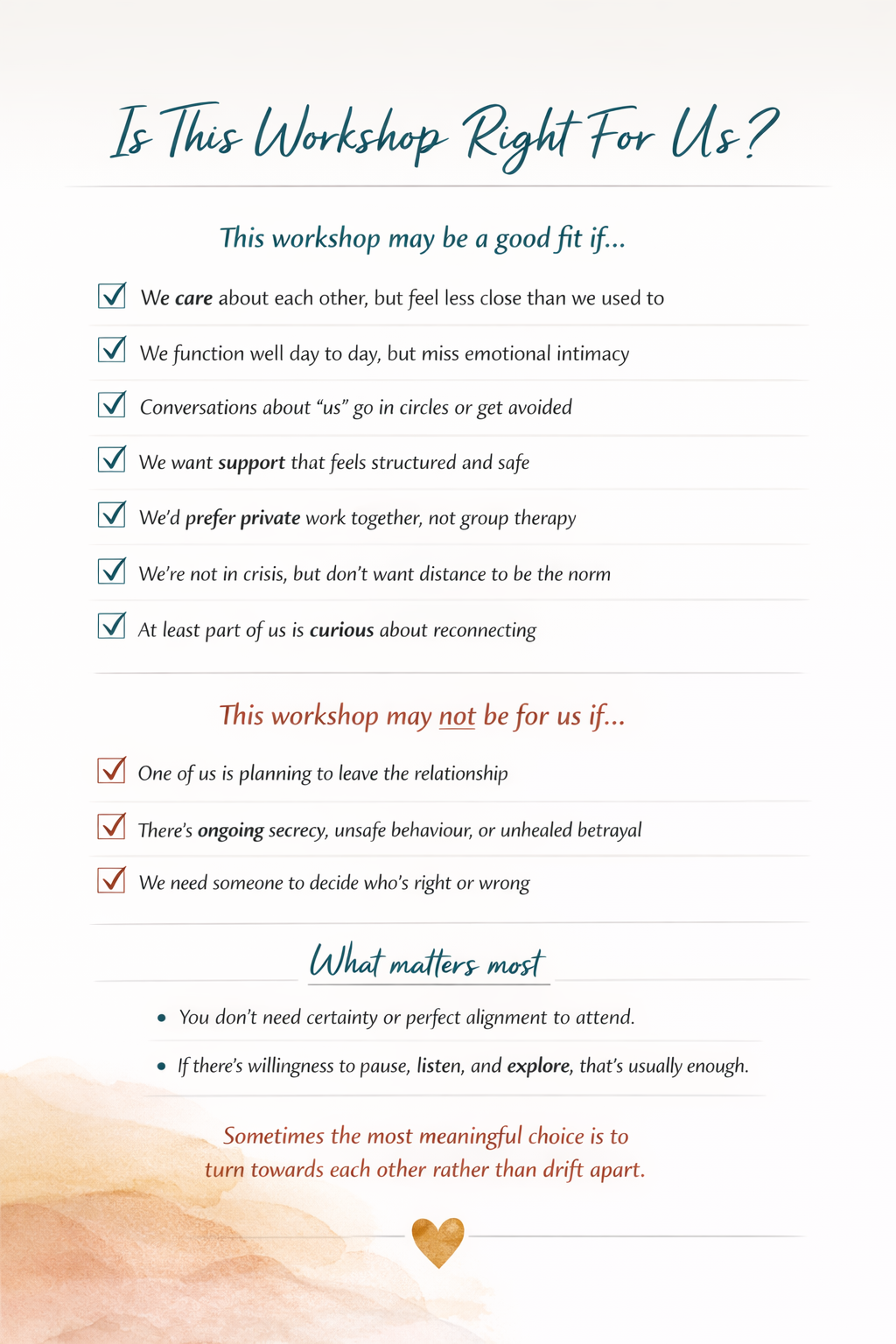

Checklist graphic titled “Is This Workshop Right For Us?” helping couples decide if a private relationship workshop is the right fit for them. Imago couples workshop. is-this-workshop-right-for-us-couples-relationship-checklist
Is this the right time to reconnect? This simple checklist helps couples decide whether the Getting the Love You Want workshop is a good fit.

Getting the Love You Want: A Psychologist’s Journey Into One of the World’s Most Transformative Relationship Workshops

After decades of working as a psychologist, couples therapist, and trainer, I thought I had seen it all when it came to helping people reconnect. Then I experienced the Getting the Love You Want weekend Imago couples workshop. It was unlike anything I had ever encountered: powerful, practical, and deeply moving, and it changed the way I think about relationships, both in my professional work, and in my marriage.

Grounded in Imago Relationship Theory, and Therapy, this internationally acclaimed program is not only for romantic couples. It is equally powerful for therapists, friends, colleagues, parent–adult child pairs, and adult siblings anyone who wants to communicate more effectively, understand each other more deeply, and build a relationship that lasts.


Where it all Began – A Love Story with Challenges

The Getting the Love You Want workshop was created by Dr Harville Hendrix, and Dr Helen LaKelly Hunt in the late 1980s. Their vision grew from both professional expertise, and personal crisis.

At one point, Helen, and Harville’s marriage was on the brink of collapse. They had even flown to New York to tell their children they were divorcing. Before meeting them, they wandered into a bookstore. That chance moment sparked deep conversations about love, safety, and connection. From that turning point, they developed the concepts and practices that became Imago Relationship Therapy (Hendrix & Hunt, 2017).


Meeting Helen in Las Vegas

A few years ago, I had the privilege of meeting Helen at the Imago International Conference in Las Vegas. She shared that story with me in person, and her openness, humour, and hope struck me. Hearing directly from one of the founders reminded me that Imago is not just a therapy model. It is a lived experience, forged in the fire of real-life relationships.


From Pain to a Global Movement

Since its creation, Imago Relationship Therapy has grown into a worldwide movement helping couples, families, and communities. In recent years, Helen, and Harville have refined their work into the 5Rs framework, a clear roadmap for creating and sustaining safe, connected relationships (Hendrix & Hunt, 2021).


The 5Rs: a Roadmap for Re-Connection

When you attend the workshop, you are guided through five key steps:

  1. Re-Commit – Making a conscious choice to invest in your relationship.
  2. Re-Image – Seeing each other with fresh eyes, free from past assumptions.
  3. Re-Structure – Learning the Intentional Dialogue, a structured way to speak and listen without defensiveness.
  4. Re-Romanticise – Rebuilding joy, appreciation, and playfulness.
  5. Re-Vision – Creating a shared vision for the future you both want.

Each step is practised in real time with your partner, colleague, or family member, so you leave not just inspired but equipped with tools you can use immediately. The bonus of having your personal workshop manual to refer to post-workshop is undeniable.


Common Fears

Many people hesitate before attending, wondering:

  • Will we have to share personal details in front of strangers?
    No. This is not group therapy. All personal work happens privately in your pair.
  • Is group sharing mandatory?
    No. Group sharing is optional and focuses on insights, not private stories.
  • What if we argue?
    The safety and structure of the Intentional Dialogue mean reactive patterns are stopped before they spiral. Our team will be there to assist you. You don’t have to go it alone.

While you work privately, seeing others practise can be inspiring. Many participants say that witnessing another pair’s courage helps them believe change is possible in their relationship.

Each step is practised in real time with your partner, colleague or family member, so you leave not only inspired but also equipped with practical tools you can start using straight away. You will also take home your own workshop manual, a valuable resource you can return to again and again to keep building your connection long after the workshop ends.


Is it Only for Couples?

While many people attend with their romantic partner, the workshop is equally powerful for:

  • Therapists attending with a colleague for professional development
  • Parent, and adult child pairs
  • Adult siblings
  • Friends or business partners wanting a deeper understanding and improved communication

Why this Work Matters to Me

As psychologists, and as a married couple, Chris, and I do not just teach relational skills; we use them. The Getting the Love You Want tools have helped us navigate differences, dramas, disconnects, deepen our understanding, and stay connected through the ups and downs of life.

Attending this weekend workshop with Chris years ago was so powerful, I am now on the journey to becoming a certified Getting the Love You Want Workshop presenter. My goal is to share this life-changing work with couples, families, and colleagues here in Australia soon.


Be the First to Know

If you are curious about the Getting the Love You Want workshop and would like to be the first to hear when I offer it, you can join my mailing list here for updates. I would love to one day meet you and share this wonderful journey with you.


References

Hendrix, H., & Hunt, H. L. (2017). Doing Imago relationship therapy in the space-between: A clinician’s guide. Routledge.


Hendrix, H., & Hunt, H. L. (2019). Getting the love you want: A guide for couples (20th anniversary ed.). St. Martin’s Griffin.


Hendrix, H., & Hunt, H. L. (2021). The space between: The 5Rs of safe and connected relationships. Penguin.


Johnson, S. M. (2019). Attachment theory in practice: Emotionally focused therapy (EFT) with individuals, couples, and families. Guilford Press.


Gottman, J. M., & Silver, N. (2015). The seven principles for making marriage work (2nd ed.). Harmony.


Tatkin, S. (2016). Wired for love: How understanding your partner’s brain and attachment style can help you defuse conflict and build a secure relationship. New Harbinger.

Book an appointment
0434 559 011
Weekdays 9am - 5pm Australian Eastern Daylight Time (UTC +11)

Book an appointment
Getting the Love You Want in March 2026

Hi there, just a quick note that we are running this renowned Imago Couples Workshop on 7-8 March in Sydney, Australia.

More details click--> Getting the Love You Want

Next workshop

Sign up for the Marriage Works Monthly Newsletter - Love in the Real World

Discover the secrets the relationship professionals recommend with a free monthly email packed with insights and inspirations for you.

Subscribe Here!