Valentine’s Day can tempt us to ask that scary yet familiar question.
What should I give my partner?
Flowers? Dinner? A surprise? Time away?
But over many years in my therapy room, I’ve noticed something important.
Most partners are not asking for something impressive.
They are asking for something specific.
The mistakes we make
We often offer love in the way we like to receive it.
If we value words, we talk. If we value gifts, we buy. If we value touch, we reach.
Meanwhile, our partner may be longing for something entirely different.
To be listened to. To be prioritised. To feel chosen. To feel safe.
When the offering misses the longing, both people can end the day puzzled.
I tried so hard.
So what does your love need?
Usually, it is one of these:
More attention. More reassurance. More affection. More appreciation. More patience.
Not bigger.
More accurate.
How to discover the answer
Instead of guessing, become curious.
You might ask:
“When do you feel most loved by me?” “What helps you feel close to me lately?” “Where do you miss me?”
These are intimate questions.
They open doors far wider than jewellery.
Why this matters
When love lands lightly, partners soften.
Defences lower. Warmth returns. Hope increases.
Feeling understood and valued is one of the most powerful romantic experiences available to us.
A beautiful Valentine’s experiment
Today, try loving your partner in the way they recognise love.
Not your default.
Theirs.
It might feel unfamiliar. It might stretch you.
It will almost certainly matter.
If the answer feels hard to hear
Sometimes partners say:
“I want more of you.” “I want you less distracted.” “I want to feel important.”
Tender information.
But also precious guidance.
Because now you know where love can grow.
What successful couples learn
Long-term intimacy is not mind-reading.
It is ongoing discovery.
Partners who stay connected keep updating their understanding of each other. They remain students of the person they love.
Curiosity becomes romance.
Final thoughts
The best gift is not extravagance.
It is accuracy.
It says I know you and what you like and love, because I love you.
If you would like support in learning how to understand each other more deeply, our couples workshops and therapy experiences are designed exactly for this work.
✨ Ask the question, or better yet, think back to the clues your loved one has given you. What they love doing, lights them up when they are speaking, the colour they love. Listen in carefully. Offer one small, specific response or take action.
That is a powerful beginning. 💛
With Love, wishing you a happy Valentines – Philipa and Chris
The fate of a relationship is usually decided in passing moments. Not in anniversaries, declarations, or dramatic turning points, but in everyday exchanges of attention, tone, and care.
What years of clinical work reveal
When couples sit down with me, they often search for the event that caused the distance.
They expect something obvious.
Yet more often, the story sounds like this:
One person tried to talk, and the other was distracted with their phone. Excitement met indifference. Vulnerability met with impatience. A bid for comfort and support landed nowhere.
Nothing catastrophic. Just repetition that leads to disconnection.
Love rarely collapses in a single day. It thins gradually when partners stop feeling met.
Why do these moments carry so much power?
Humans are wired for responsiveness. When a reach for connection is answered warmly, the body settles. Safety registers. Trust accumulates.
When the reach is missed, uncertainty grows.
A relationship is built from thousands of these exchanges. The pattern becomes the climate. The climate becomes the story partners tell themselves about being together.
What is it that thriving couples do differently?
They are not more sophisticated. They are more responsive to each other regularly.
They look up. They pause. They ask another question. They repair quickly after missteps.
What are the early warning signs most people miss?
Disconnection rarely announces itself loudly at first.
It appears as reduced curiosity. A flatter tone. More time out. Less turning towards.
This is the moment to act, long before resentment hardens.
This is the most useful question you can ask tonight
When my partner reached for me today, what did they receive from me?
Blame is not the aim. Awareness is.
Once you notice, you regain influence.
What partners report when they shift this
Change tends to be gentle.
We are kinder. We recover faster. I feel closer again.
Not fireworks. Stability.
And stability is what allows affection to grow.
A practice that works in real homes
Next time your partner speaks, let there be a visible moment of arrival as you:
Turn your body. Meet their eyes. Respond with interest and curiosity.
You are communicating value.
Why dependability is deeply romantic
Intensity is exciting, but unpredictability is exhausting.
Knowing someone will be there, again and again, is what makes closeness sustainable.
Reliable connection is the soil romance grows in.
Frequently asked questions
Is something this small truly influential? Yes. Repeated responsiveness reshapes how safe people feel with each other.
What if I am making the effort alone? One partner’s shifting behaviour often softens the relational atmosphere. If progress stalls, support can help both people re-engage.
Do gestures and surprises still matter? They are meaningful when built on everyday contact. Novelty keeps up excitement energy.
Reflections
Every interaction moves a relationship slightly towards closeness or distance. You can choose –
For therapists considering referring individuals or couples they are seeing to couples therapy
Clinicians often tell me they want somewhere safe to send couples for structured relationship education, knowing those clients will be supported and then returned to ongoing care.
Couples gain practical skills in emotional responsiveness, communication, and repair. They return back to youwith shared language, clearer insight, and renewed motivation, which often accelerates progress in individual or couple sessions.
Many referring practitioners notice:
✔ improved stability between sessions ✔ reduced escalation ✔ greater accountability from both partners ✔ more productive therapeutic conversations
You are always welcome to reach out to discuss whether a couple is suitable.
What makes or breaks love in a relationship?
Love is strengthened or weakened in everyday interactions. When partners respond to each other with attention, warmth, and interest, emotional safety grows. When bids for connection are repeatedly ignored or dismissed, distance develops. Over time, these small moments shape the future of the relationship.
Can small behaviours really change a relationship?
Yes. Consistent responsiveness influences how secure partners feel with one another. Even brief moments of eye contact, listening, or gentle acknowledgement can rebuild trust when practised regularly.
What is a bid for connection?
A bid for connection is any small attempt to gain a partner’s attention, support, or closeness. It might be sharing a thought, asking for help, making a joke, or reaching for touch. Turning towards these bids strengthens intimacy.
Why do couples drift apart?
Drift often occurs when partners stop responding to each other’s small emotional signals. The lack of acknowledgement accumulates, leading to feelings of loneliness, misunderstanding, and disconnection.
How can couples reconnect quickly?
Start by noticing moments when your partner reaches for you. Pause, turn towards them, and respond with curiosity or care. Repeating this pattern creates momentum towards closeness.
Practical steps to begin to be the change you want to see
Notice one bid for connection. Respond warmly. Repeat tomorrow and the next day. Allow momentum to build. Smile more, share appreciation and kindness.
For many couples, intimacy doesn’t disappear overnight.
It fades quietly.
You still care about each other. You still function well as a team. Life keeps moving – work, family, commitments – and from the outside everything looks fine.
But something subtle has changed.
Conversations stay practical. Touch becomes brief or absent. You miss the ease you once had, the friendship, the sense of being emotionally close. You may not argue much, but you don’t feel particularly connected either.
In long-term relationships, this experience is far more common than people realise. And it often leaves couples wondering: Is this just what happens over time?
The answer is no. But what helps is not always what people expect.
Why intimacy fades even when love remains
In our work with couples, we often see that intimacy doesn’t fade because partners stop loving each other. It fades because emotional safety becomes thinner over time.
Small moments of disconnection add up. Missed bids for attention. Conversations that feel tense or go nowhere. Old hurts that never quite get repaired. Each experience subtly teaches the nervous system whether it’s safe to open up or better to stay guarded.
Most couples don’t consciously decide to pull away. They adapt.
They become efficient. Polite. Careful. And gradually, the relationship shifts from emotionally alive to emotionally managed.
Trying harder or “communicating better” rarely solves this, because intimacy isn’t created by effort alone. It’s created when both partners feel safe enough to be real with each other again.
Why talking about the problem often isn’t the solution
Many couples try to fix fading intimacy by talking about it more.
Ironically, this can make things worse.
When conversations feel charged, one partner may push for closeness while the other pulls back. One feels unheard. The other feels criticised. Both leave the interaction feeling less safe than before.
This isn’t a lack of goodwill. It’s a lack of structure.
Without a container that slows things down and reduces reactivity, even well-intentioned conversations can reinforce distance rather than heal it.
What actually helps when intimacy fades
What helps most is not insight alone, but experience.
Couples need opportunities to experience each other differently – to listen and be listened to in ways that feel safe, contained, and meaningful. When the nervous system settles, intimacy often follows naturally.
This is the foundation of the Getting the Love You Want workshop. This couple’s intensive weekend retreat has helped thousands of couples reconnect, re-experience joy and renew desire.
Rather than analysing the relationship or focusing on what’s gone wrong, the workshop provides a structured, private environment where couples can reconnect through guided experiences.
It’s not group therapy. It’s not about sharing personal stories publicly.
Couples spend most of the time working one-to-one with each other, supported by a clear relational process that helps conversations slow down and feel safer.
What couples often notice during the workshop
Many couples are surprised by what shifts.
They notice how quickly defensiveness drops when conversations are structured. They begin to hear their partner in a new way – not just the words, but the meaning underneath.
For couples who have lost a sense of friendship, this can be deeply relieving. Instead of feeling like they’re negotiating or defending positions, they experience moments of genuine understanding.
These moments matter. Intimacy is rebuilt not through grand gestures, but through repeated experiences of feeling emotionally met.
Why this approach works for long-term couples
Long-term relationships carry history. Patterns. Memory.
The Getting the Love You Want workshop is based on an internationally recognised relationship model that understands this reality. Rather than blaming individuals or labelling relationships as “unhealthy,” it focuses on how connection is created, lost, and restored over time.
This approach has been used by couples around the world because it respects both partners and prioritises safety. When people feel safe, closeness becomes possible again.
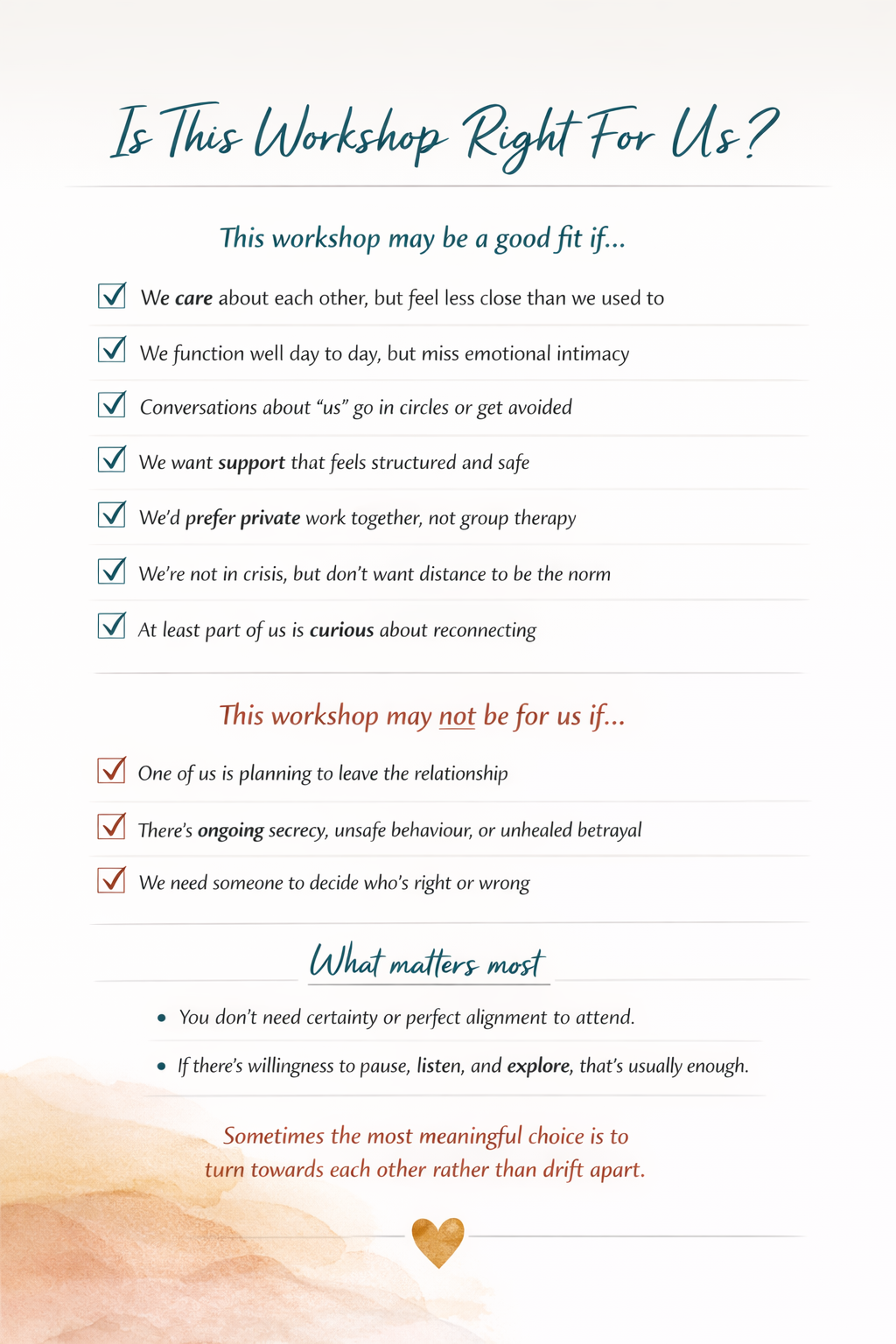
“We’re not in crisis – is this still relevant?”
This is one of the most common questions couples ask.
The truth is that many of the couples who benefit most are not in crisis at all. They are still committed. They still care. They simply don’t want emotional distance to become the norm.
Intervening at this stage is often far more effective than waiting until resentment or withdrawal has taken hold.
Choosing to invest in connection early is not an admission of failure. It’s an act of care for you, your relationship and your loved ones.
A different kind of choice
When intimacy fades, couples often tell themselves they’ll deal with it later, when things slow down, when life is less busy, when it becomes unavoidable.
But closeness rarely returns on its own.
The Getting the Love You Want workshop offers couples a chance to pause, step out of daily patterns, and reconnect in a way that is structured, respectful, and deeply human.
Not because something is broken. But because what matters deserves attention.
Sometimes what actually helps is not waiting, not pushing harder, and not drifting further apart, but deliberately choosing to turn back towards each other.
Frequently Asked Questions
Is this workshop only for couples in crisis?
No. Many couples attend because they still care deeply about each other but feel less connected than they used to. The workshop is especially helpful when intimacy and friendship have faded, even if there’s no major conflict.
Is the Getting the Love You Want workshop group therapy?
No. This is not group therapy. While the workshop is held with other couples present, most of the work is done privately, one-to-one with your partner. Sharing with the group is always optional.
What if we’re not good at talking about feelings?
That’s very common. The workshop provides a clear structure that helps conversations feel safer and less overwhelming. You don’t need to be articulate or emotionally skilled to benefit.
Do we need to prepare or read anything beforehand?
No preparation is required. You simply come as you are. The workshop is designed to meet couples where they’re at, without homework or prior reading.
How is this different from couples counselling?
Rather than ongoing sessions, the workshop offers a focused, immersive experience over two days. Many couples find this helps them shift patterns more quickly and gives them tools they can continue using afterwards.
What if one of us is unsure about attending?
That hesitation is very common. You don’t need to be certain or have a shared goal beyond wanting things to feel better. Curiosity and willingness are enough.
No affairs. No dramatic blow-ups. No talk of separation.
From the outside, they look like a solid couple. They work, parent, manage life, and get through the week. There’s care, loyalty, and shared history.
Yet somewhere along the way, the aliveness between them has faded.
Evenings are quieter than they used to be. Conversations stay practical. Touch is brief. Intimacy feels awkward or effortful.
When they try to talk about it, the conversation goes in circles, or one of them shuts down.
Eventually, one of them says it out loud:
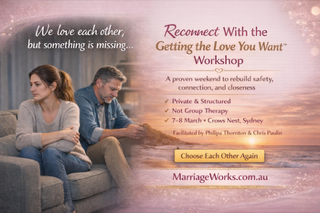
“We love each other, but something is missing.”
This is a composite couple, drawn from the many couples who come to this work. And if this sounds familiar, you’re not alone.
Why talking harder hasn’t worked
Most couples in this place have already tried.
They’ve had “the talk”. They’ve promised to try harder. They’ve read articles or listened to podcasts.
And yet, nothing really shifts.
That’s because disconnection isn’t usually a communication problem. It’s a relational safety problem.
Over time, small hurts accumulate. Moments of feeling unseen or misunderstood don’t quite get repaired. Each partner adapts in quiet ways – withdrawing a little, pleasing a little more, avoiding certain topics, protecting themselves from disappointment.
No one is doing anything wrong. They’re doing what humans do when closeness starts to feel risky.
Love is still there. But safety has thinned.
The insight behind the Getting the Love You Want Imago approach
The Getting the Love You Want workshop is grounded in Imago Relationship Therapy, a relationship model developed over four decades ago.
Imago began with a deceptively simple question: Why do loving relationships so often get stuck in the same painful patterns?
The answer was both relieving and confronting.
According to Imago, we are unconsciously drawn to partners who reflect not only the best of what we knew growing up, but also the unresolved emotional wounds. Not because we enjoy pain, but because our nervous system is seeking growth, repair, and completion.
This explains something many couples quietly struggle with:
Why the person you love most can also trigger you most. Why the same arguments repeat, even with good intentions. Why trying harder doesn’t necessarily create closeness.
Rather than seeing conflict as failure, Imago reframes it as a signal – an invitation to slow down, listen differently, and rebuild connection with intention.
From a therapy model to a global relationship movement
What began in therapy rooms quickly grew into a global approach to relationship repair and growth.
Imago Relationship Therapy is now practised in nearly 50 countries, with thousands of trained professionals supporting couples worldwide. The book Getting the Love You Want became an international bestseller because it offered something many couples had never experienced before:
A way to understand why they were stuck A structure for difficult conversations And a path back to connection without blame
Today, the Getting the Love You Want workshop is one of the most widely attended relationship workshops in the world, offered across the US, UK, Europe, and Australia.
Not because it promises perfection – but because it creates safety.
Why the workshop format works so well
Many couples arrive having already tried counselling or “talking it through” on their own.
What’s different about this workshop is the container.
It’s not group therapy. It’s not about sharing your story publicly.
It’s a private, structured, two-day experience where you work primarily one-to-one with your partner, guided through a clear process that helps you:
Slow conversations down so they don’t escalate
Feel heard without defensiveness
Speak without blame or shutdown
Understand what’s happening beneath the surface
Rebuild safety, step by step
Most of the work happens between the two of you. Sharing with the group is always optional.
Couples often say the workshop creates a different kind of shift because you’re not dipping in and out of the work. You’re immersed. Supported. Contained.
Instead of analysing your relationship, you experience being listened to differently.
And that experience is what creates change.
“We’re not in crisis – is this still for us?”
One of the biggest myths about relationship support is that you need to be at breaking point.
In reality, many couples attend the Getting the Love You Want workshop at exactly the point where things are still intact, but connection is thinning.
They’re committed. They care. They just don’t feel met anymore.
This is often the most powerful moment to intervene.
Because rebuilding connection is far easier than repairing damage done by years of emotional distance, resentment, or quiet loneliness.
An invitation to choose each other again
If you recognised yourself in this story – loving each other, functioning well, but sensing that something essential is missing – this is your gentle nudge.
The Getting the Love You Want relationship workshop is running 7–8 March in Crows Nest, Sydney.
It’s private. It’s structured. And it’s designed for couples who want to reconnect before disconnection becomes the norm.
You don’t need to be in crisis. You just need to be willing to slow down and choose each other again.
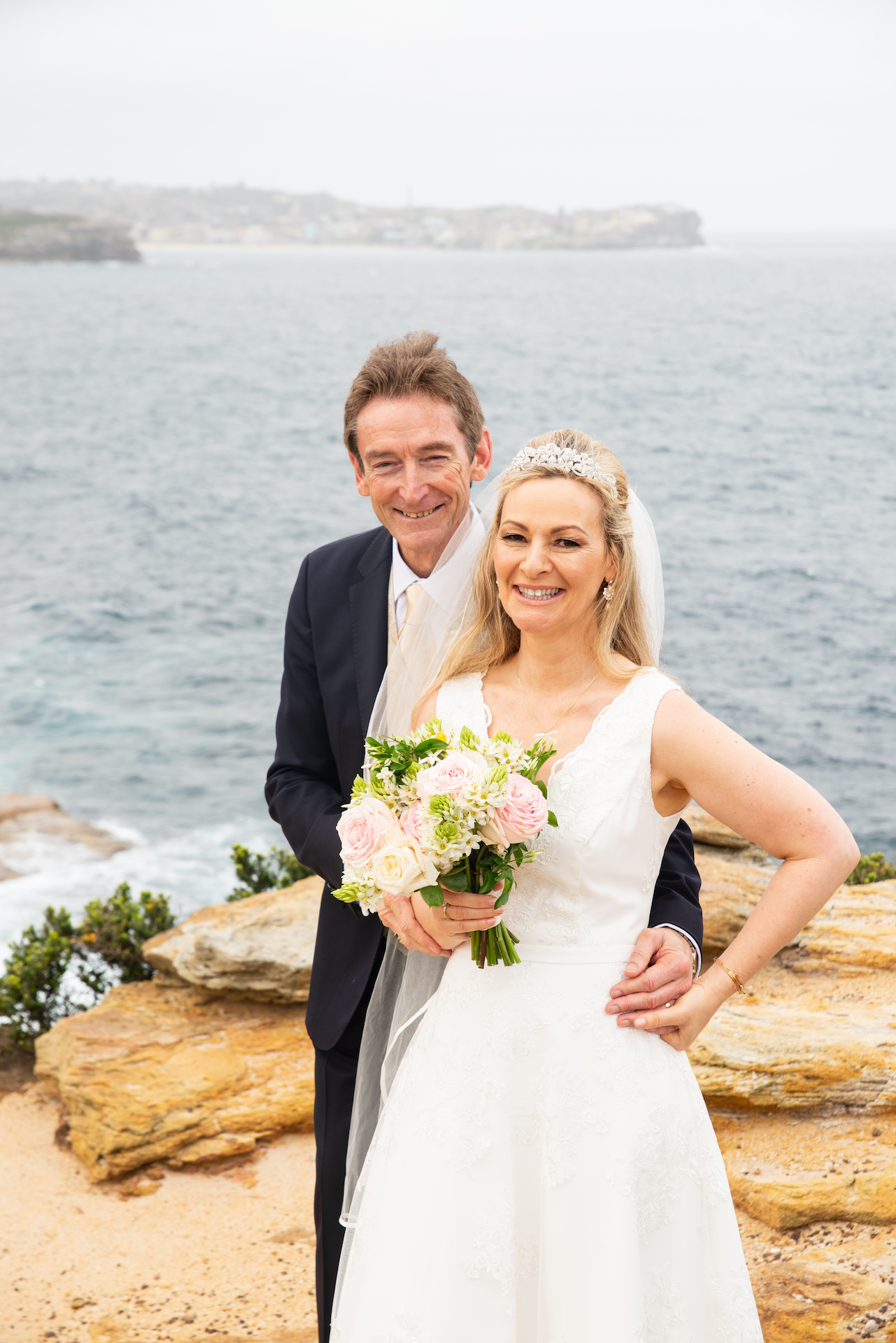
When Chris and I first attended a Getting the Love You Want workshop, we weren’t there as psychologists or presenters. We were there as a couple.
Two life partners who wanted to strengthen our relationship, communicate better, and stop going around in the same familiar loops.
That first weekend changed everything.
We sat side by side, learning how to slow down, really listen, and understand each other in new ways.
For Chris, who holds a Master’s degree in Clinical Psychology and brings over 40 years of experience to his work, it was refreshing to sit in the chairs simply as a partner. For me, it was deeply moving to feel our connection shift in real time.
Chris, true to form, though nervous, was also cheering me on with his quiet humour, keeping time, offering snacks, and grounding the moment when things felt intense. That experience didn’t just support our relationship. It inspired us both.
Thats why we want to invite you to our next Getting the Love You Want Couples Workshop – we know we did!