Valentine’s Day can tempt us to ask that scary yet familiar question.
What should I give my partner?
Flowers? Dinner? A surprise? Time away?
But over many years in my therapy room, I’ve noticed something important.
Most partners are not asking for something impressive.
They are asking for something specific.
The mistakes we make
We often offer love in the way we like to receive it.
If we value words, we talk. If we value gifts, we buy. If we value touch, we reach.
Meanwhile, our partner may be longing for something entirely different.
To be listened to. To be prioritised. To feel chosen. To feel safe.
When the offering misses the longing, both people can end the day puzzled.
I tried so hard.
So what does your love need?
Usually, it is one of these:
More attention. More reassurance. More affection. More appreciation. More patience.
Not bigger.
More accurate.
How to discover the answer
Instead of guessing, become curious.
You might ask:
“When do you feel most loved by me?” “What helps you feel close to me lately?” “Where do you miss me?”
These are intimate questions.
They open doors far wider than jewellery.
Why this matters
When love lands lightly, partners soften.
Defences lower. Warmth returns. Hope increases.
Feeling understood and valued is one of the most powerful romantic experiences available to us.
A beautiful Valentine’s experiment
Today, try loving your partner in the way they recognise love.
Not your default.
Theirs.
It might feel unfamiliar. It might stretch you.
It will almost certainly matter.
If the answer feels hard to hear
Sometimes partners say:
“I want more of you.” “I want you less distracted.” “I want to feel important.”
Tender information.
But also precious guidance.
Because now you know where love can grow.
What successful couples learn
Long-term intimacy is not mind-reading.
It is ongoing discovery.
Partners who stay connected keep updating their understanding of each other. They remain students of the person they love.
Curiosity becomes romance.
Final thoughts
The best gift is not extravagance.
It is accuracy.
It says I know you and what you like and love, because I love you.
If you would like support in learning how to understand each other more deeply, our couples workshops and therapy experiences are designed exactly for this work.
✨ Ask the question, or better yet, think back to the clues your loved one has given you. What they love doing, lights them up when they are speaking, the colour they love. Listen in carefully. Offer one small, specific response or take action.
That is a powerful beginning. 💛
With Love, wishing you a happy Valentines – Philipa and Chris
The fate of a relationship is usually decided in passing moments. Not in anniversaries, declarations, or dramatic turning points, but in everyday exchanges of attention, tone, and care.
What years of clinical work reveal
When couples sit down with me, they often search for the event that caused the distance.
They expect something obvious.
Yet more often, the story sounds like this:
One person tried to talk, and the other was distracted with their phone. Excitement met indifference. Vulnerability met with impatience. A bid for comfort and support landed nowhere.
Nothing catastrophic. Just repetition that leads to disconnection.
Love rarely collapses in a single day. It thins gradually when partners stop feeling met.
Why do these moments carry so much power?
Humans are wired for responsiveness. When a reach for connection is answered warmly, the body settles. Safety registers. Trust accumulates.
When the reach is missed, uncertainty grows.
A relationship is built from thousands of these exchanges. The pattern becomes the climate. The climate becomes the story partners tell themselves about being together.
What is it that thriving couples do differently?
They are not more sophisticated. They are more responsive to each other regularly.
They look up. They pause. They ask another question. They repair quickly after missteps.
What are the early warning signs most people miss?
Disconnection rarely announces itself loudly at first.
It appears as reduced curiosity. A flatter tone. More time out. Less turning towards.
This is the moment to act, long before resentment hardens.
This is the most useful question you can ask tonight
When my partner reached for me today, what did they receive from me?
Blame is not the aim. Awareness is.
Once you notice, you regain influence.
What partners report when they shift this
Change tends to be gentle.
We are kinder. We recover faster. I feel closer again.
Not fireworks. Stability.
And stability is what allows affection to grow.
A practice that works in real homes
Next time your partner speaks, let there be a visible moment of arrival as you:
Turn your body. Meet their eyes. Respond with interest and curiosity.
You are communicating value.
Why dependability is deeply romantic
Intensity is exciting, but unpredictability is exhausting.
Knowing someone will be there, again and again, is what makes closeness sustainable.
Reliable connection is the soil romance grows in.
Frequently asked questions
Is something this small truly influential? Yes. Repeated responsiveness reshapes how safe people feel with each other.
What if I am making the effort alone? One partner’s shifting behaviour often softens the relational atmosphere. If progress stalls, support can help both people re-engage.
Do gestures and surprises still matter? They are meaningful when built on everyday contact. Novelty keeps up excitement energy.
Reflections
Every interaction moves a relationship slightly towards closeness or distance. You can choose –
For therapists considering referring individuals or couples they are seeing to couples therapy
Clinicians often tell me they want somewhere safe to send couples for structured relationship education, knowing those clients will be supported and then returned to ongoing care.
Couples gain practical skills in emotional responsiveness, communication, and repair. They return back to youwith shared language, clearer insight, and renewed motivation, which often accelerates progress in individual or couple sessions.
Many referring practitioners notice:
✔ improved stability between sessions ✔ reduced escalation ✔ greater accountability from both partners ✔ more productive therapeutic conversations
You are always welcome to reach out to discuss whether a couple is suitable.
What makes or breaks love in a relationship?
Love is strengthened or weakened in everyday interactions. When partners respond to each other with attention, warmth, and interest, emotional safety grows. When bids for connection are repeatedly ignored or dismissed, distance develops. Over time, these small moments shape the future of the relationship.
Can small behaviours really change a relationship?
Yes. Consistent responsiveness influences how secure partners feel with one another. Even brief moments of eye contact, listening, or gentle acknowledgement can rebuild trust when practised regularly.
What is a bid for connection?
A bid for connection is any small attempt to gain a partner’s attention, support, or closeness. It might be sharing a thought, asking for help, making a joke, or reaching for touch. Turning towards these bids strengthens intimacy.
Why do couples drift apart?
Drift often occurs when partners stop responding to each other’s small emotional signals. The lack of acknowledgement accumulates, leading to feelings of loneliness, misunderstanding, and disconnection.
How can couples reconnect quickly?
Start by noticing moments when your partner reaches for you. Pause, turn towards them, and respond with curiosity or care. Repeating this pattern creates momentum towards closeness.
Practical steps to begin to be the change you want to see
Notice one bid for connection. Respond warmly. Repeat tomorrow and the next day. Allow momentum to build. Smile more, share appreciation and kindness.
For many couples, intimacy doesn’t disappear overnight.
It fades quietly.
You still care about each other. You still function well as a team. Life keeps moving – work, family, commitments – and from the outside everything looks fine.
But something subtle has changed.
Conversations stay practical. Touch becomes brief or absent. You miss the ease you once had, the friendship, the sense of being emotionally close. You may not argue much, but you don’t feel particularly connected either.
In long-term relationships, this experience is far more common than people realise. And it often leaves couples wondering: Is this just what happens over time?
The answer is no. But what helps is not always what people expect.
Why intimacy fades even when love remains
In our work with couples, we often see that intimacy doesn’t fade because partners stop loving each other. It fades because emotional safety becomes thinner over time.
Small moments of disconnection add up. Missed bids for attention. Conversations that feel tense or go nowhere. Old hurts that never quite get repaired. Each experience subtly teaches the nervous system whether it’s safe to open up or better to stay guarded.
Most couples don’t consciously decide to pull away. They adapt.
They become efficient. Polite. Careful. And gradually, the relationship shifts from emotionally alive to emotionally managed.
Trying harder or “communicating better” rarely solves this, because intimacy isn’t created by effort alone. It’s created when both partners feel safe enough to be real with each other again.
Why talking about the problem often isn’t the solution
Many couples try to fix fading intimacy by talking about it more.
Ironically, this can make things worse.
When conversations feel charged, one partner may push for closeness while the other pulls back. One feels unheard. The other feels criticised. Both leave the interaction feeling less safe than before.
This isn’t a lack of goodwill. It’s a lack of structure.
Without a container that slows things down and reduces reactivity, even well-intentioned conversations can reinforce distance rather than heal it.
What actually helps when intimacy fades
What helps most is not insight alone, but experience.
Couples need opportunities to experience each other differently – to listen and be listened to in ways that feel safe, contained, and meaningful. When the nervous system settles, intimacy often follows naturally.
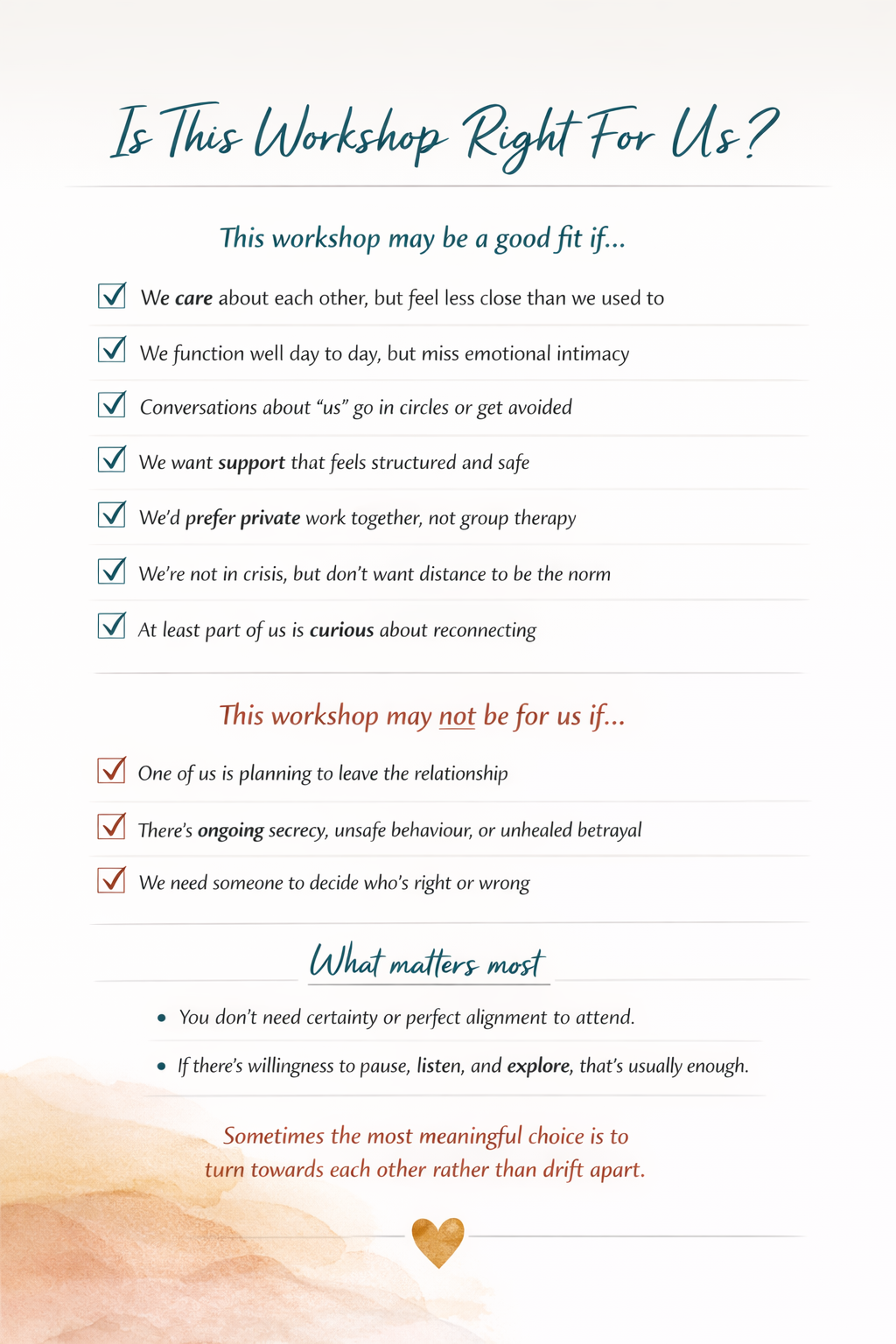
This is the foundation of the Getting the Love You Want workshop. This couple’s intensive weekend retreat has helped thousands of couples reconnect, re-experience joy and renew desire.
Rather than analysing the relationship or focusing on what’s gone wrong, the workshop provides a structured, private environment where couples can reconnect through guided experiences.
It’s not group therapy. It’s not about sharing personal stories publicly.
Couples spend most of the time working one-to-one with each other, supported by a clear relational process that helps conversations slow down and feel safer.
What couples often notice during the workshop
Many couples are surprised by what shifts.
They notice how quickly defensiveness drops when conversations are structured. They begin to hear their partner in a new way – not just the words, but the meaning underneath.
For couples who have lost a sense of friendship, this can be deeply relieving. Instead of feeling like they’re negotiating or defending positions, they experience moments of genuine understanding.
These moments matter. Intimacy is rebuilt not through grand gestures, but through repeated experiences of feeling emotionally met.
Why this approach works for long-term couples
Long-term relationships carry history. Patterns. Memory.
The Getting the Love You Want workshop is based on an internationally recognised relationship model that understands this reality. Rather than blaming individuals or labelling relationships as “unhealthy,” it focuses on how connection is created, lost, and restored over time.
This approach has been used by couples around the world because it respects both partners and prioritises safety. When people feel safe, closeness becomes possible again.
“We’re not in crisis – is this still relevant?”
This is one of the most common questions couples ask.
The truth is that many of the couples who benefit most are not in crisis at all. They are still committed. They still care. They simply don’t want emotional distance to become the norm.
Intervening at this stage is often far more effective than waiting until resentment or withdrawal has taken hold.
Choosing to invest in connection early is not an admission of failure. It’s an act of care for you, your relationship and your loved ones.
A different kind of choice
When intimacy fades, couples often tell themselves they’ll deal with it later, when things slow down, when life is less busy, when it becomes unavoidable.
But closeness rarely returns on its own.
The Getting the Love You Want workshop offers couples a chance to pause, step out of daily patterns, and reconnect in a way that is structured, respectful, and deeply human.
Not because something is broken. But because what matters deserves attention.
Sometimes what actually helps is not waiting, not pushing harder, and not drifting further apart, but deliberately choosing to turn back towards each other.
Frequently Asked Questions
Is this workshop only for couples in crisis?
No. Many couples attend because they still care deeply about each other but feel less connected than they used to. The workshop is especially helpful when intimacy and friendship have faded, even if there’s no major conflict.
Is the Getting the Love You Want workshop group therapy?
No. This is not group therapy. While the workshop is held with other couples present, most of the work is done privately, one-to-one with your partner. Sharing with the group is always optional.
What if we’re not good at talking about feelings?
That’s very common. The workshop provides a clear structure that helps conversations feel safer and less overwhelming. You don’t need to be articulate or emotionally skilled to benefit.
Do we need to prepare or read anything beforehand?
No preparation is required. You simply come as you are. The workshop is designed to meet couples where they’re at, without homework or prior reading.
How is this different from couples counselling?
Rather than ongoing sessions, the workshop offers a focused, immersive experience over two days. Many couples find this helps them shift patterns more quickly and gives them tools they can continue using afterwards.
What if one of us is unsure about attending?
That hesitation is very common. You don’t need to be certain or have a shared goal beyond wanting things to feel better. Curiosity and willingness are enough.
The separation of Nicole Kidman and Keith Urban after almost twenty years together has sparked global attention. Some of us may be shocked, disappointed, and others may say the writing was on the wall. While celebrity stories often focus on glamour or scandal, as a couple’s psychologist, I see something deeper: the universal dynamics of love, loss, and how relationships evolve.
Imago Relationship Therapy offers a powerful lens here. It teaches that we are drawn to partners who mirror both our childhood love and our deepest hurts. These unconscious dynamics provide enormous growth potential but can also create tension. Through this perspective, their separation offers lessons we can all learn from.
Separation as evolution is not ending
Media reports describe this as a “strategic separation” rather than a divorce. We can guess this is simply a tactic to handle marriage breakdown in a public arena by being in control of the messaging. Wise move. In Imago terms, this framing suggests an attempt to move beyond unconscious patterns into a more conscious decision about what the relationship needs. By speaking of evolution, they reduce shame and keep the door open for future possibilities.
Public image versus private vulnerability
For years, the couple’s red-carpet affection may have contrasted with unspoken struggles behind the scenes. Big careers, time apart, and disconnection, living parallel lives.
This mirrors how many couples, not only celebrities, present a strong public face while silently suffering. This is the couple where you would say they seemed so good, so loving, we never saw that coming. Imago reminds us that real intimacy happens when masks drop and partners meet each other with honesty and empathy, not performance.
Life stage and accumulated pressures
After nearly two decades, pressures from careers, parenting teenagers, and personal transitions, grief and loss often converge. In Imago, we understand this as a natural stage, the move from romantic love into the power struggle, and then, if embraced, into a conscious relationship of deeper love. The key is whether couples choose to engage with these challenges or retreat from them.
Communication and unmet needs
“I need space” often signals unmet needs that have not been voiced or heard. It’s the escape hatch to stepping further away from a marriage. Without safe dialogue, partners may turn to silence, and withdraw to survive. A lonely existence. Imago Dialogue, with its emphasis on mirroring, validation, and empathy, offers a way back to being truly heard. Without it, distance replaces intimacy.
Silent divorce: when connection fades without words
Some couples separate with drama. Others drift apart quietly. The Kidman Urban separation has been framed as respectful and intentional, but it could also be seen as a kind of silent divorce – when disconnection builds slowly, with little outward conflict, until the bond quietly dissolves.
A silent divorce can be harder to notice than open fighting. Partners may live parallel lives, whilst they avoid conflict, the price paid is avoiding intimacy.
The absence of arguments does not mean health. It may mean both have stopped hoping to be understood. A death knell in romantic relationships.
The good news is that silence is not irreversible. If couples recognise it early, therapy can help them reintroduce dialogue and rediscover the desire to connect.
The first step is breaking the silence. This takes courage. How can Imago Relationship Therapy help? Imago counsellors assist couples in coaching tried, and true communication skills that get to the heart of the issues.
Family, dignity, and legacy
With two daughters, their separation highlights the importance of modelling dignity. Children learn about love, conflict, and repair from what they observe. Even if a couple does not stay together, they can show that endings need not be destructive. Respectful separation can create a legacy of care rather than bitterness. Children are the passengers in this and don’t get a choice. So it’s vital to share age appropriately and shift to co-parenting strategies of support.
Frequently Asked Questions
What is a silent divorce?
A silent divorce is when partners slowly disconnect emotionally, often without fighting or dramatic conflict. They may appear fine to others, but feel lonely and unheard inside the relationship.
Why do long-term marriages end?
Long-term marriages often end due to accumulated stresses: career demands, parenting, identity changes, or unspoken needs. Inability to share beyond complaint, forgotten fun, lack of novelty, those surprises which remind us of our special bond, and emotional loneliness are what I have seen and heard in my office. Over time, the distance can grow until separation feels like the only option. Or there’s a bombshell, like an affair, that goes off in the relationship.
How can couples avoid a silent divorce?
The key is intentional communication. Couples need safe ways to voice needs, frustrations, and longings before silence takes over. Approaches like Gottman, EFT, and Imago Dialogue help partners listen deeply and reconnect to unmet needs. A relationship coach can guide you beyond frustration patterns toward a fulfilling partnership.
Is separation always negative?
Not necessarily. For some couples, separation provides breathing space to reflect and reset. If there are children involved, there will be an ongoing connection. For others, it allows each partner to grow individually while still honouring the relationship’s history.
How can therapy help during separation?
Couples Therapy provides a structured and compassionate space to reduce blame, shame, lower barriers of protective parts, express emotions, and explore choices. Couples may use this time to repair and recommit, or to separate respectfully with clarity and care. Individual therapy can assist in learning and healing from the break-up whilst holding on to your dignity.
Reflections
The Kidman Urban separation reminds us that relationships are not static. They are living systems that require dialogue, intention, and care. 19 years for a successful celebrity couple like Nicol and Keith is a testament to their love and I would guess hard work in and on their relationship, no doubt with professional support along the way.
Whether couples stay together or part ways, the goal is not perfection but authenticity of self, meeting each other with empathy, compassion, and if necessary, choosing to separate with dignity.
With Love and light,
Philipa.
P.S. Don’t leave it too late, reach out to repair today and book your appointment with Chris or me.
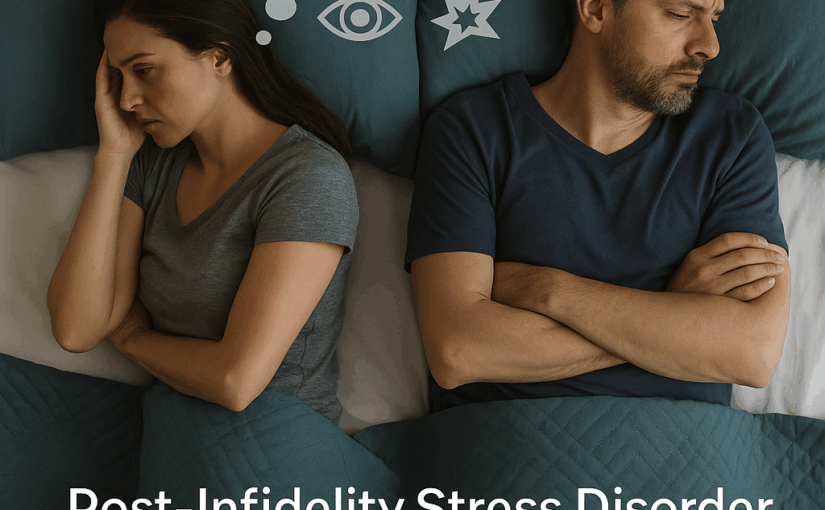
Understanding Post‑Infidelity Stress Disorder (PISD) Through a Resource Therapy Lens
After infidelity, many betrayed partners report feeling paralysed, emotionally frozen between fear, longing, rage, and grief. This experience is often misunderstood as simply being “unable to move on.”
In reality, it reflects deep psychological trauma, increasingly recognised as Post‑Infidelity Stress Disorder (PISD).
Using a parts-based framework, such as Resource Therapy (Emmerson, 2014), we can make sense of this stuckness, and offer compassionate, targeted strategies for healing.
What Is Post‑Infidelity Stress Disorder?
Post‑Infidelity Stress Disorder (PISD) is a non-diagnostic term originally coined by clinical psychologist Dennis Ortman to describe PTSD-like symptoms experienced after discovering infidelity (as cited in Gupta, 2023). While not recognised in the DSM-5, PISD has gained traction among therapists and betrayed partners as a meaningful way to understand the intense emotional trauma that can follow a relational betrayal.
Symptoms of PISD often mirror those of post-traumatic stress disorder (PTSD) and may include:
Hypervigilance and scanning for danger
Emotional reactivity or shutdown
Nightmares or mental replays
Anxiety, confusion, and numbness
Difficulty regulating trust—even in future relationships
These are not overreactions. They are survival responses from parts of the self trying to protect against further emotional injury (Emmerson, 2014; Gupta, 2023; Mays, 2023).
The Resource Therapy Perspective: Who’s on Deck?
In Resource Therapy, these trauma responses are understood as the voices of different Resource States—distinct personality parts that step forward to manage overwhelming emotional experiences.
For example:
The hypervigilant part may be a Retro Protector State constantly scanning for betrayal to prevent more pain.
The confused or foggy part may be a Vaded in Confusion State, frozen in endless loops of “Why did this happen?”
The collapsed or despairing part may be a Vaded in Rejection or Fear State, reliving past attachment injuries.
Each part has a role, a voice, and a need. When these parts are unacknowledged or unsupported, they dominate the inner world—leaving the person feeling overwhelmed, stuck, and emotionally hijacked.
Why the Tug-of-War Feels Impossible
One of the most painful patterns in betrayal trauma is the internal push-pull between:
“I want to stay, rebuild, and feel loved again…”
“I cannot trust them or feel safe anymore.”
In Resource Therapy, we understand this as either:
A Conflicted State, where two opposing Resource States are active at the same time—one pushing for reconnection, the other retreating in fear or anger
Or a Vaded in Confusion State, where a part is paralysed in uncertainty and emotional fog, looping endlessly through “Why?”
These States cannot be “thought out of” with logic. They require part-specific access, emotional witnessing, and therapeutic relief (Emmerson, 2014).
When Early Attachment Wounds Reactivate
Infidelity rarely exists in a vacuum. For many, it reactivates older attachment injuries—from inconsistent parenting, abandonment, conditional love, or emotional neglect. These early wounds get stirred up, making the betrayal feel existential (Johnson, 2019; Levine & Heller, 2010).
Resource Therapy allows us to identify and work with the exact part that holds those early experiences. That part can be accessed, heard, and updated with new corrective experiences—creating genuine healing repair, not just coping.
Hypervigilance Is Not “Crazy”—It’s Protective
Betrayal often leads to a surge in behaviours like:
Checking phones, emails, or locations
Replaying conversations
Watching for signs of micro-expression shifts or tone changes
These behaviours are sometimes labelled as “controlling” or “irrational.” But in Resource Therapy, we recognise these as the actions of Retro States—protector parts doing their best to avoid being blindsided again (Emmerson, 2014).
This is not pathology—it is protection.
The Physical Cost of Betrayal Trauma
Betrayal does not just affect the mind—it shows up in the body. A 2024 study found that individuals who experienced infidelity were significantly more likely to report long-term physical symptoms such as:
Migraines
Cardiovascular strain
Gastrointestinal issues
Sleep disruption
Increased inflammatory responses (Oh & Hoy, 2024)
Even with strong external support, these physical manifestations can persist if the inner Resource States holding trauma are not accessed and treated.
Healing Is Possible—When the Right Part Is Heard
Traditional talk therapy may not reach the part of the self carrying the pain. This is where Resource Therapy offers a unique and effective solution.
Rather than working generically, RT provides part-specific, trauma-informed access:
Vivify the part that needs help
Bridge to the original wound or belief
Express safely and fully
Update the part with new resolution
Anchor the person back in conscious control and present-day safety
When the right part is seen and heard, the stuckness begins to shift. Integration replaces paralysis. Peace becomes possible.
You Are Not Broken—You Are Carrying Too Much
If you are a betrayed partner, know this: the way you feel makes sense. You are not weak. You are not overreacting. Your Resource parts are working hard to protect you.
And if you are a therapist, Resource Therapy gives you the tools to guide this healing journey with clarity, safety, and profound results.
🛋️ Want to Help Clients Heal After Betrayal?
Join the Clinical Resource Therapy Training 📅 Starts 31 August 2025 – Online 👩⚕️ With Philipa Thornton, Psychologist & RTI President 🌐 www.resourcetherapy.com.au
📚 References
Emmerson, G. J. (2014). Resource Therapy Primer, Old Golden Point Press.
Freyd, J. J. (1996). Betrayal trauma: The logic of forgetting childhood abuse. Harvard University Press.
You may have seen the viral kiss-cam clip from a Coldplay concert. A couple is caught on screen. Instead of leaning in, they freeze. Pull away. Their faces say it all—shock, fear, panic.
Social media lit up with theories. Was it an affair? A secret? A mistake caught live?
As a couples therapist, I saw something deeper: A trauma response. A nervous system overwhelmed. A moment where the body said, “This is not safe.”
Because when trust is broken—publicly or privately—it can feel like an emotional earthquake.
🧠 Betrayal, Infidelity, and Secrets Can Mimic PTSD Symptoms
You do not need to go to war to experience trauma. You only need to feel helpless, unsafe, or deeply hurt.
In relationships, this can look like:
Flashbacks or obsessive thoughts about what happened
Difficulty sleeping or eating
A constant feeling of walking on eggshells
Feeling numb, frozen, or overly reactive
Panic, dread, or emotional shutdown when triggered
These are not “overreactions”—they are your nervous system trying to protect you.
💬 “Why Can’t I Just Get Over It?”
I hear this all the time in my practice. You may love your partner and still feel unsafe. You may desperately want to move forward—but feel stuck in replay, confusion, or mistrust.
That is not weakness. That is a trauma wound, calling for care—not criticism.
Whether it was a betrayal, infidelity, emotional withdrawal, or a rupture you cannot name—your pain is valid. And repair is possible.
🪷 The Healing Power of Therapy and Couples Work
When a relationship injury happens, many couples do not know how to repair it, especially when both are hurting.
That is where therapy or a workshop can help you:
Understand and name what happened (and what it meant to each of you)
Learn how to regulate intense emotions and triggers
Rebuild emotional safety, one interaction at a time
Create new ways of connecting with honesty and care
Therapy provides a safe, structured space for your nervous systems to settle—and for your hearts to open again.
💛 Your Pain Is Real. And So Is the Possibility of Repair.
If the kiss-cam story hit a nerve for you… If you are still carrying the aftershocks of betrayal, secrecy, or silence… Please know this:
You are not broken. And you are not alone.
With support, couples can navigate even the deepest pain toward trust, truth, and emotional reconnection.
If you are ready to begin, Chris and I are here.
Reach out today by calling or emailing us. We are here for you.
By Philipa Thornton, Relationship Psychologist & Imago Couples Therapist President, Resource Therapy International
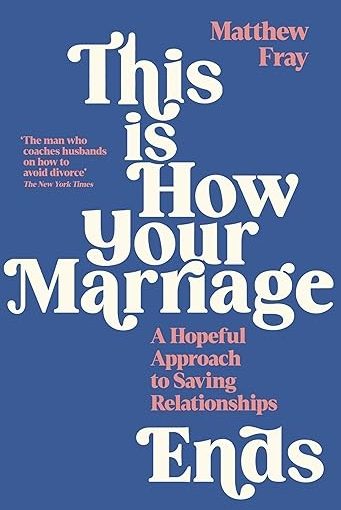
If I could hand every couple I see one book to read before the wheels fall off, This Is How Your Marriage Ends by Matthew Fray would be high on the list.
Not because it is full of fluffy romantic advice. Not because it gives you a 5-step formula to “fix” your partner. But because it gets painfully real, surprisingly funny, and devastatingly accurate about what actually erodes love.
And spoiler alert – it is not the big betrayals or dramatic moments. It is the empty glass left on the bench after you have asked – again – for it to be put in the dishwasher.
📖 Featured Book: This Is How Your Marriage Ends by Matthew Fray
The Glass Isn’t The Problem – It’s What It Symbolises
Fray knows this because he lived it. A man who lost his marriage not in one catastrophic moment, but through hundreds of tiny, seemingly insignificant moments of “not getting it.” He thought he was a good husband. He was a good guy. But good intentions do not equal good impact.
The book opens with the story of the glass, how his wife asks him to put his used glass in the dishwasher. He doesn’t. She stops asking. And if you’ve ever had a partner, this hits you square in the chest. We all have our ‘glass’.
You can see both sides: the person who thinks “it’s just a glass, what’s the big deal?” and the partner who feels dismissed, disrespected, and unseen – again.
Fray writes with wit and self-deprecating charm, and beneath the humour lies something deeper: a call to wake up to how our everyday behaviours either build trust or slowly dismantle it. There’s hope here.
We Haven’t Been Taught How To Relationship
One of the most refreshing aspects of this book is that Fray doesn’t shame anyone. Instead, he shows us that most of us simply haven’t been taught the skills we need to do relationships well. This fits in with Imago Relationship Coaching beautifully –
We assume love is enough
We assume good intentions matter most
We assume that if something doesn’t make sense to us, it shouldn’t really matter
That – Fray argues – is where so many of us go wrong.
It is this lack of empathy in action that leads to resentment, disconnection, and heartbreak.
What I Love, And What I Recommend
As a couples therapist, I see this dynamic play out in session after session. It is rarely “infidelity”, “money”, or “sex” that is the true issue, though they may be symptoms.
The underlying cause is often this exact pattern Fray describes:
One partner raises a concern (e.g. the glass)
The other minimises it (“It’s not a big deal”)
The first feels dismissed, not heard
The cycle repeats
Resentment builds
Intimacy fades
And finally, someone says, “I just can’t do this anymore”
Fray writes in a way that is particularly accessible, especially for men and anyone who struggles to see how their good intentions can still cause harm. His voice reminds me of The Subtle Art of Not Giving a F*ck by Mark Manson, and the relationship wisdom of The 5 Love Languages.
I especially offer this book to the men I coach who want to understand the nuances – what went wrong, and how to get it right moving forward. It invites insight and ownership, and it does so without shame or blame. It opens up reflection in a way that is honest and transformative.
You will laugh, and you will cringe. You might want to throw the book across the room (especially if your partner is reading it and starts underlining passages). But more than that, you will see yourself, and that is what makes this book so powerful.
Final Thoughts, And A Gentle Invitation
What Fray learned the hard way is something many of us need to learn, ideally before we lose what matters most. It is not just about putting the glass in the dishwasher. It is about showing that your partner’s feelings matter. That their needs matter. That they matter.
And yes, we can learn that.
Whether through books like this, or guided support such as our Imago workshops, therapy, or intensives, healing is possible – and deeply rewarding.
Because maybe – just maybe – this is how your marriage begins again.
One of the most joyful concepts in Imago Relationship Therapy is re-romanticising. This concept involves intentionally reviving the spark, appreciation, and playfulness that often fade in long-term relationships.
If you have ever thought, “We love each other, but the fun has disappeared,” you are not alone.
Life gets busy. Stress, work, parenting, and emotional disconnection can take their toll.
But the good news is that connection and joy can return when we put intention behind our actions.
What Is Re-Romanticising?
In Imago Relationship Theory, re-romanticising is about reawakening positive energy in your relationship. It is not about grand gestures or manufactured romance. It is about making small, consistent choices that help your partner feel seen, valued, and loved.
Think of it as a return to those early days when everything felt exciting. But this time, you are doing it with deeper understanding and intention. You choose connection, even when it does not come easily.
Why Fun Is Foundational
One of the most overlooked ingredients in a healthy relationship is fun. Playful moments help us bond, regulate stress, and remember why we chose each other in the first place.
In our Marriage Works couples sessions, we often hear things like:
“We do not laugh together anymore.”
“We have lost our spark.”
“Everything feels like a to-do list.”
If this sounds familiar, it might be time to prioritise joy again. That can look as simple as:
Dancing in the kitchen
Sharing a funny memory or an inside joke
Sending a flirty message midday
Taking a walk without your phones
Playing a silly board game or card game
Joy is not frivolous. It is fuel for emotional safety, resilience, and intimacy.
Bringing Pleasure Back
Another part of re-romanticising is reconnecting physically and emotionally through pleasure. In long-term relationships, physical intimacy can become routine or even disappear altogether.
When we lose playfulness, desire often fades too. But pleasure can be a powerful way to reconnect. Not just sexually, but in all five senses. Holding hands. Making eye contact. Laughing and exploring touch in a non-pressured way.
This is where tools like OMGYes can make a real difference.
What Is OMGYes?
OMGYes is a research-based platform that explores what brings women physical pleasure. Based on findings from over 20,000 people, it offers videos, interviews, and interactive touchable tools that help users explore intimacy with confidence and clarity.
It is practical, inclusive, and designed to help couples talk more openly about what feels good.
Many of the couples we see use OMG Yes as a fun, non-threatening way to start conversations about sex and connection.
It is not therapy, but it can be a helpful complement to your journey together.
Try this: do one thing this week to re-romanticise your relationship. Choose something fun, light, and a little bit unexpected.
Focus on connection, not perfection.
And if you would like structured support with your relationship, consider joining one of our Getting the Love You Want workshops. These transformative weekends help couples heal patterns, increase safety, and bring joy back into the relationship.
Because love is not just about staying together. It is about thriving together.
Philipa Thornton, psychologist and certified Imago Relationship Therapist at Marriage Works. We help couples reconnect through the power of intention, dialogue, and fun.
Welcome to August, I am a little late getting this to you. It’s been a busy time of online training for the Resource Therapy Institute – sorry!
Know that I am sending you all love, support, and appreciation for wherever you are on your relationship journey.
Married, de facto, or single, we at Marriage Works seek to assist you live your life’s dreams and highest potential. I do work with singles for coaching to help you change past patterns of relationship and assist you in repairing your self- worth. You are lovable and good enough, truly!
The theme for this month is Self- Respect.
Naturally people want respect in their relationships.
When I ask what this means in therapy sessions, I often get either a stunned look or a few descriptions rattled off.
We often haven’t really had the chance to ponder what respect and self-respect are. How they play out.
This is your mission for the month to think on what it means and how Self Respect shows up for you, or not as the case may be.
What is my definition of Self Respect ?
How do I allow this to show up in my life? What values am I connecting with when I do this?
Self Respect is both an action and an internal compass. It can be as simple as what I choose to eat – is it nourishing for my body. Where my focus goes, is it toward my goals? Am I listening to myself or am I looking for external approval for acknowledgement.
How do I validate my thoughts and feelings. Do I speak kindly, compassionately to myself.
Would I treat others better than I treat myself, ie would I not listen to my intuition and tolerate unhelpful patterns out of fear?
Is my need for approval leading me to lose my self respect? How do I regain the balance?
Please share as I am extremely curious, especially in this world COVID crisis as to how you live this or reconnect with the treasure you are. When we treat ourselves with dignity and gravitas, how do others respond?
Love to hear drop a comment in the box below your musings and definitions. Thanks ever so much,
Welcome back to the Marriage Works Monthly Challenge Series. This is really a call to action to encourage share your positive parts to the world. This is for you no matter what your relationship status.
This month as we start to unfurl from lockdown’s, COVID 19 restrictions I ask you to share your kindness.
For some of us, this will be anxiety-provoking, possibly overwhelm, for others of us it may be a relief.
Whatever your reaction is, know it is all within the normal range to an abnormal situation.
Our partners can have their unique reactions to this so please be mindful and generous to their experiences.
So please share kindness. ?
I am a kiwi at home in Sydney (New Zealander for those who don’t know the euphemism). Being from a small town Thames it’s natural to say Hi and smile at folks when we are out and about. This can be such a goodwill gesture and often rewarded in kind.
Start with small.
Sometimes we have the opportunity to do more. I have had a friend who unexpectedly ended up in hospital. She called and I was able to get her clothes, supplies, feed her cat Izzy and support her. She is out now of danger and things are improving thank goodness.
Here’s the YouTube Marriage Works Channel video on Sharing kindness ? Hear how I responded when a lady got anxious and told me off at the mall.